| Rodney Nillsen's website
Home Page email: nillsen@uow.edu.au |
Mathematical Research II
|
|
|
Sums associated with orbits in the binary dynamical system. In 1930, G. H. Hardy and J. E. Littlewood derived results concerning rates of divergence of certain series involving cosecants. One result was that for certain real numbers $\theta$, there is $K>0$ such that
\[\sum_{k=1}^n\frac{1}{sin^2(k\theta\pi)}\le Kn^2, \ {\rm for\ all}\ n\in {\mathbb N}.
\]
In more recent terminology, this can be interpreted as a result about orbits in a dynamical system that is a rotation on the unit circle. Now, the expansion of numbers in the unit interval $[0,1)$ to the base $2$ can be associated with the binary system $([0,1),f)$, where $f:[0,1)\longrightarrow [0,1)$ is given by
\[
f(x)=
\begin{cases}
2x, \ {\rm for}\ 0\le x<1/2,\\
2x-1, {\rm for}\ 1/2\le x<1.\\
\end{cases}
\]
A number in $[0,1)$ is called a binary rational if it is not of the form $k/2^n$ for some $0\le k<2^n$, and $f^k$ denotes the $k^{th}$ iterate of $f$. Given a number in $[0,1)$ that is not a binary rational, and given $p>0$, we find upper and lower estimates for each of
\[\sum_{k=1}^n\frac{1}{f^{k-1}(x)^p} \ {\rm and}\ \frac{1}{n}\left(\sum_{k=1}^n\frac{1}{f^{k-1}(x)^p}\right),\]
where $n=1,2,3,\ldots.$
These estimates are in terms of the lengths of the blocks of zeros and ones in the binary expansion of $x$. In each case, a necessary and sufficient condition on the blocks is found for the `equivalence' of the upper and lower estimates. In the case of the right-hand exression, this is a semi-symmetric 'regularity' condition on the blocks. The numbers in $[0,1)$ that satisfy the regularity condition have measure $1$, and include all base two simply normal numbers and all algebraic numbers that are not binary rationals. If a number is not a binary rational and does not satisfy the regularity condition then it is a Liouville number, and there is an uncountable set of such numbers. This work has appeared in Real Analysis Exchange, 50 (1), pp. 15-52, 2025.
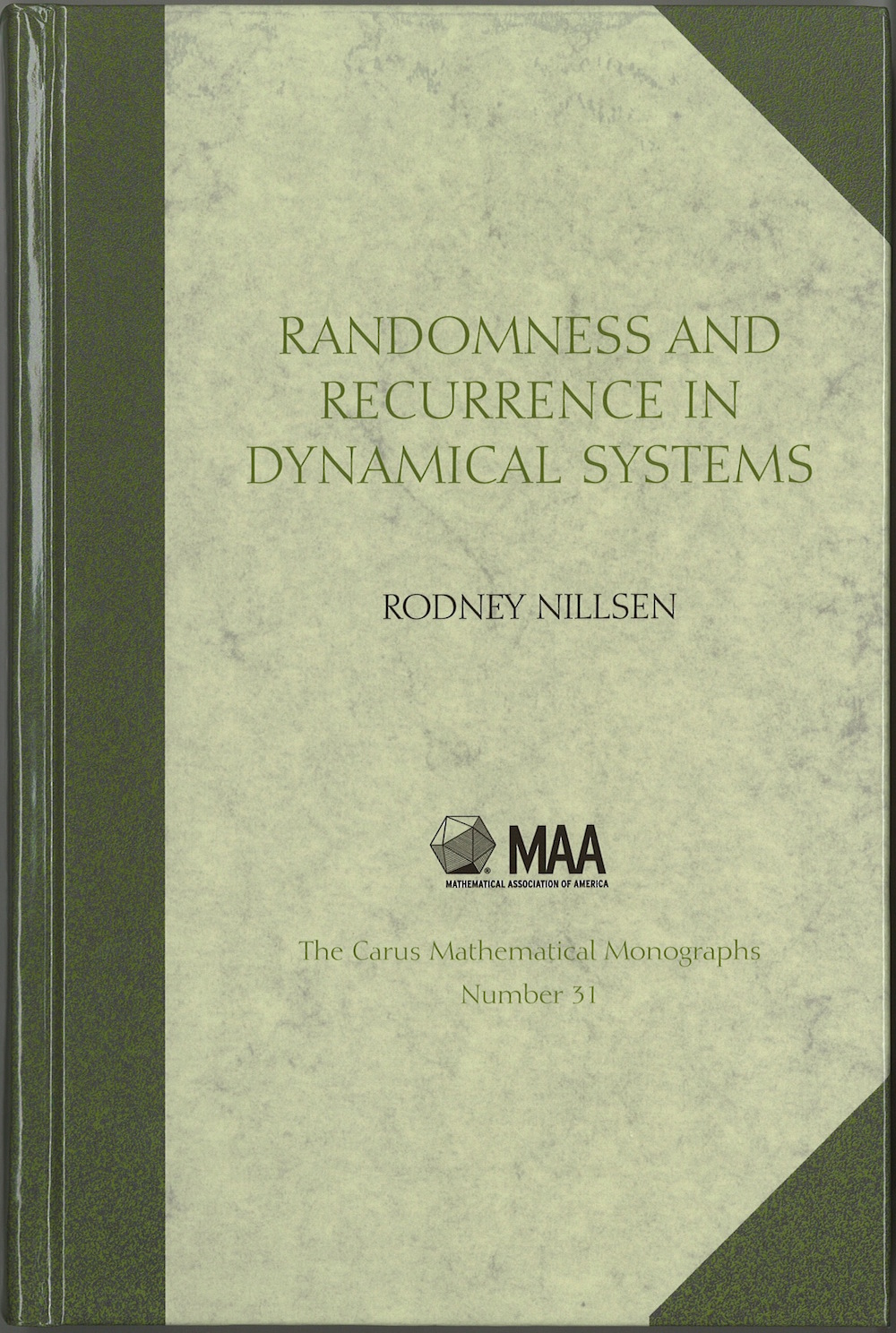
Dynamical systems, randomness and probability. The book Randomness and Recurrence in Dynamical Systems, was published by the Mathematical Association of America in 2010. This book fits no easy category. It is primarily expository at the undergraduate/lower postgraduate level but contains substantial research aspects. The book arose from a course on chaos theory and dynamical systems and from the paper Normal numbers without measure theory. The main aim was to eliminate the need for a preliminary knowledge of measure theory in presenting proofs of some famous classical results in real analysis and probability that were normally only accessible at the postgraduate and research level. However, subsidiary aims were: to set the ideas within the unifying concept of a dynamical system, to motivate the work from one stage to next, to provide clarity and completeness in the proofs, to provide exercises that encouraged the reader to carry out independent investigation, and to use illustrations to help achieve these objectives.
There are reviews of this book by David Hand, Svitlana P. Rogovchenko and James A. Walsh. Read further reviews and more about this book. I received great help and encouragement in writing this book from Kenneth A. Ross of The University of Oregon, and I gratefully acknowledge his interest, erudition and practical advice. Discrete orbits in $\beta{\mathbb N}-{\mathbb N}$. Let ${\mathbb N}$ denote the set of natural numbers and let $\beta{\mathbb N}-{\mathbb N}$ be the Stone-Cech compactification of $\mathbb N$. The shift mapping $n\longmapsto n+1$ mapping $\mathbb N$ into $\mathbb N$ extends to a continuous mapping from $\beta{\mathbb N}$ into $\beta {\mathbb N}$ and its retriction to $\beta{\mathbb N}-{\mathbb N}$ is a homeomorphism of $\beta{\mathbb N}-{\mathbb N}$. Denote this restriction by $\sigma$. Thus $\sigma:\beta{\mathbb N}-{\mathbb N} \longrightarrow \beta{\mathbb N}-{\mathbb N}$ is a homeomorphism of $\beta{\mathbb N}-{\mathbb N}$. The paper
Discrete orbits in $\beta{\mathbb N}-{\mathbb N}$, is concerned with when the obit $\{\omega, \sigma(\omega),\sigma^2(\omega),\ldots \}$ of a point $\omega\in \beta{\mathbb N}- {\mathbb N}$ is a discrete subset of $\beta{\mathbb N}- {\mathbb N}$.
Banach Limits. Banach limits are continuous invariant linear forms on the Banach space of bounded sequences. They form a compact convex set in the weak*-topology of the dual of this space. It was proved in the paper Nets of extreme Banach limits that the set of extreme points of this set is non-compact. Some related research may be found in selected publications. A recent survey article by Evgenii Semenov, Fedor Sukochev and Alexandr Usachev considers more recent research on Banach limits and their applications. They have a conjecture that the above-mentioned result on the extreme points in the set of Banach limits (proved independently by M. Talagrand) extends to a more general context. Their article may be viewed here. Rodney Nillsen, page updated 21st January, 2026 |