| Rodney Nillsen's website
Home Page email: nillsen@uow.edu.au |
Mathematical Research I
|
|
|
Fourier analysis research
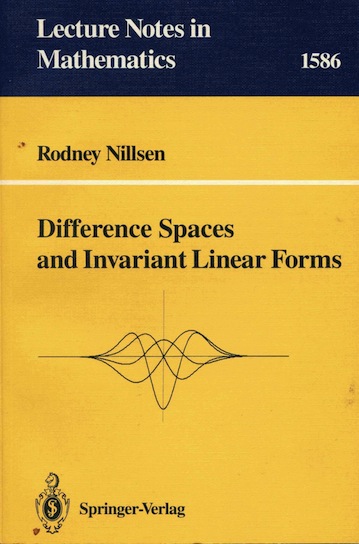
The work of Meisters and Schmidt left open the question of what happens when $\mathbb R$ is considered in place of $\mathbb T$. Again consider only square integrable functions. The Fourier transform of a function $f$ on $\mathbb R$ is given by \[{\widehat f}(x)=\int_{-\infty}^{\infty}f(u)\,e^{-iux}du, \ {\rm for}\ x\in {\mathbb R}.\] Also, a function $g$ on $\mathbb R$ is called a first order difference, if there are $b\in {\mathbb R}$ and a function $h$ such that \[g(x)=h(x)-h(b+x), \ {\rm for\ almost\ all}\ x\in {\mathbb R}.\] If can be checked that if $f$ is a sum of a finite number of first order differences, then \[\int_{-\infty}^{\infty}|{\widehat f}(x)|^2|x|^{-2}dx<\infty.\] A type of converse result is: if $\int_{-\infty}^{\infty}|{\widehat f}(x)|^2|x|^{-2}dx<\infty$, then $f$ is a sum of three first order differences and that, as in the case of $\mathbb T$ above, three is sharp. As a result, if we let ${\cal D}({\mathbb R})$ denote the vector space of all finite sums of first order differences on $\mathbb R$, then ${\cal D}({\mathbb R})$ is a Hilbert space with an inner product $\langle \cdot,\cdot \rangle$ given by \[\langle f,g\rangle=\int_{-\infty}^{\infty}\, \left(1+\frac{1}{|x|^2}\right){\widehat f}(x){\overline{{\widehat g}(x)} } \,dx.\] It follows from these ideas that ${\cal D}({\mathbb R})$ is the range of the differentiation operator $D$ on the first order Sobolev space on $\mathbb R$. Let ${\cal D}({\mathbb T})$ denote the vector space of all finite sums of first order differences on $\mathbb T$. Then, note that the the membership of a function in ${\cal D}({\mathbb T})$ or ${\cal D}({\mathbb R})$ is determined by the behaviour of the Fourier coeffcient at the origin in the case of $\mathbb T$, or by the behaviour of the Fourier transform near the origin in the case of $\mathbb R$. The above results were developed further for ${\mathbb R}^n$ in the research monograph Difference Spaces and Invariant Linear Forms, which introduced the notion of difference spaces and their connection with differential operators and singular integrals. An invited talk on this research, dedicated to Gary H. Meisters, was presented at a conference in Lincoln, Nebraska in 1997 in honour of his work. The recent paper Vanishing Fourier coefficients and the expression of functions in $L^2({\mathbb T})$ as sums of generalised differences characterises functions whose Fourier transform vanishes at two points of $\mathbb Z$. Go to selected publications for further work and publications on Fourier analysis. Rodney Nillsen |
 Let ${\mathbb T}$ denote the set of complex numbers of modulus $1$. Let ${\mathbb R}$ denote the set of real numbers. We consider only complex valued functions, square integrable on $\mathbb T$ in the Lebesgue sense. Then if $f$ is a function on $\mathbb T$, its Fourier coefficients ${\widehat f}(n)$ are given by
\[{\widehat f}(n)=\int_{\mathbb T} f(z)\,z^{-n}dz, \ {\rm for}\ n=0,\pm1,\pm2,\ldots.\]
Also, a function $g$ on $\mathbb T$ is called a first order difference if there are $b\in {\mathbb T}$ and a function $h$ such that
\[g(z)=h(z)-h(bz), \ {\rm for\ almost\ all}\ z\in {\mathbb T}.\]
It is easy to check that if $f$ is a first order difference, ${\widehat f}(0)=0$.
In 1974 Gary H Meisters and Wolfgang Schmidt proved a type of converse statement. Namely, if ${\widehat f}(0)=0$, $f$ can be written as a sum of three first order differences. They also showed that in this statement three is sharp in that it cannot be replaced by two.