Quantitative Analysis of Indexing
Outline
Cost model ? What is it ?
- A model used for estimation of the cost of various database operations
- Notation
- b => the total number of fully packed blocks
- r => an average number of rows per block
- f => fanout of B*-tree index
- k => number of keys in an index
Quantitative Analysis of Indexing
Outline
Storage organizations and models
- Tables with the randomly ordered rows
- Tables with the clustered B*-tree indices
- Tables with the unclustered B*-tree indices
Quantitative Analysis of Indexing
Outline
Tables with randomly ordered rows
- Full scan
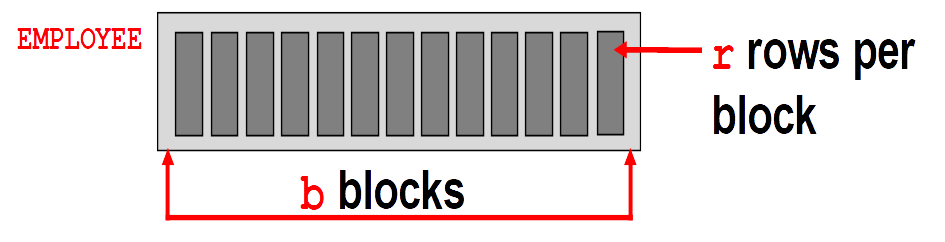
- Cost = b read block operations
Tables with randomly ordered rows
- Full scan with an equality condition on a key
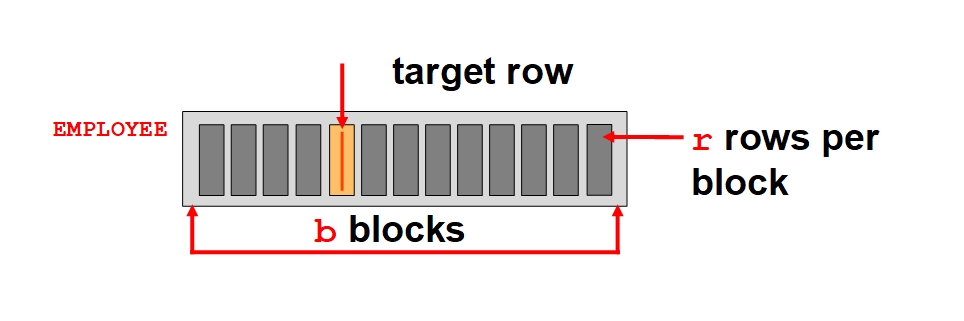
- Cost = (1 + b)/2 read block operations
Tables with randomly ordered rows
- Full scan with a range condition
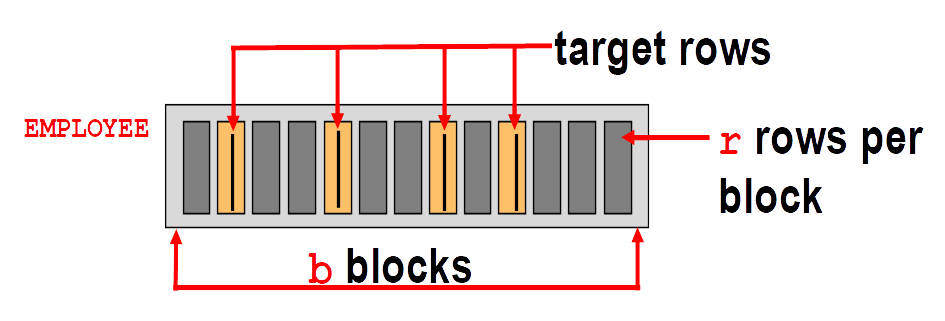
- Cost = b read block operations
Quantitative Analysis of Indexing
Outline
Table with clustered B* tree index
-
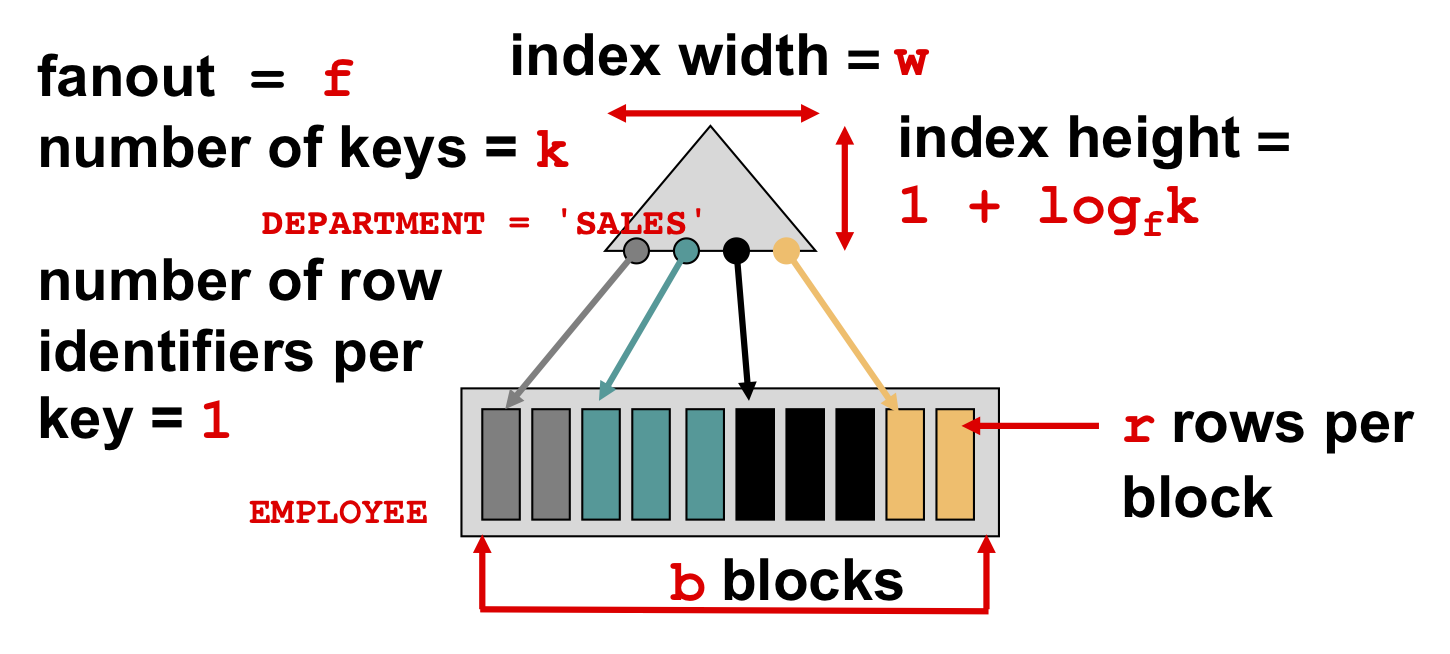
- Average number of blocks that contain all rows with the same value of index key = b/k
Table with clustered B* tree index
- Full scan with an equality condition on a cluster key
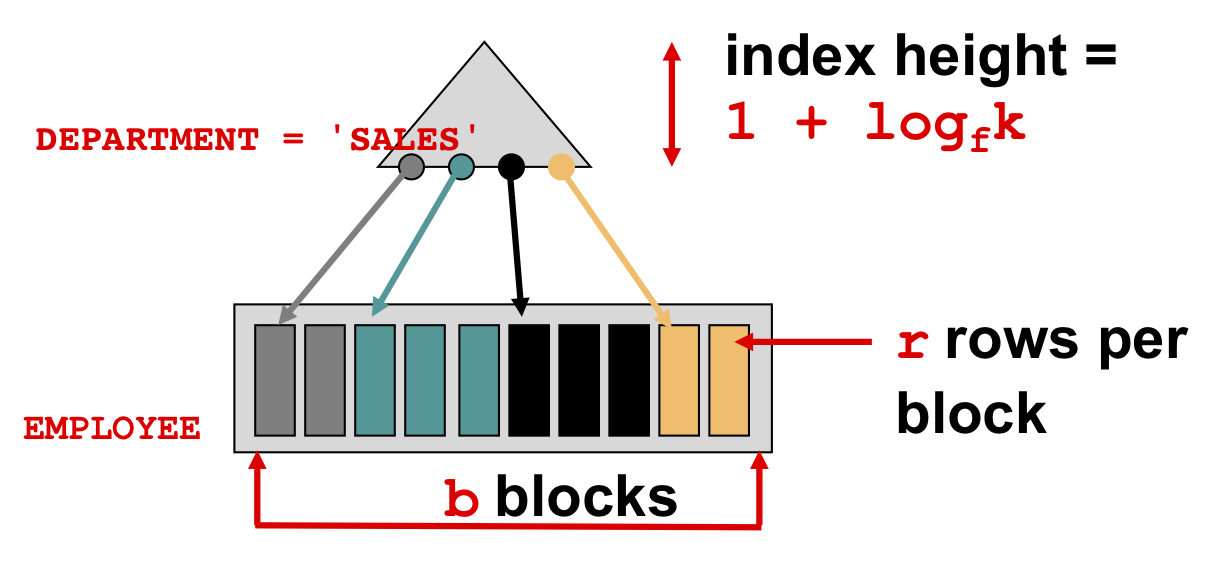
- Cost = 1+logfk + b/k read block operations
Table with clustered B* tree index
- Full scan with a range condition on a cluster key where n is a number of cluster keys that satisfy the range condition
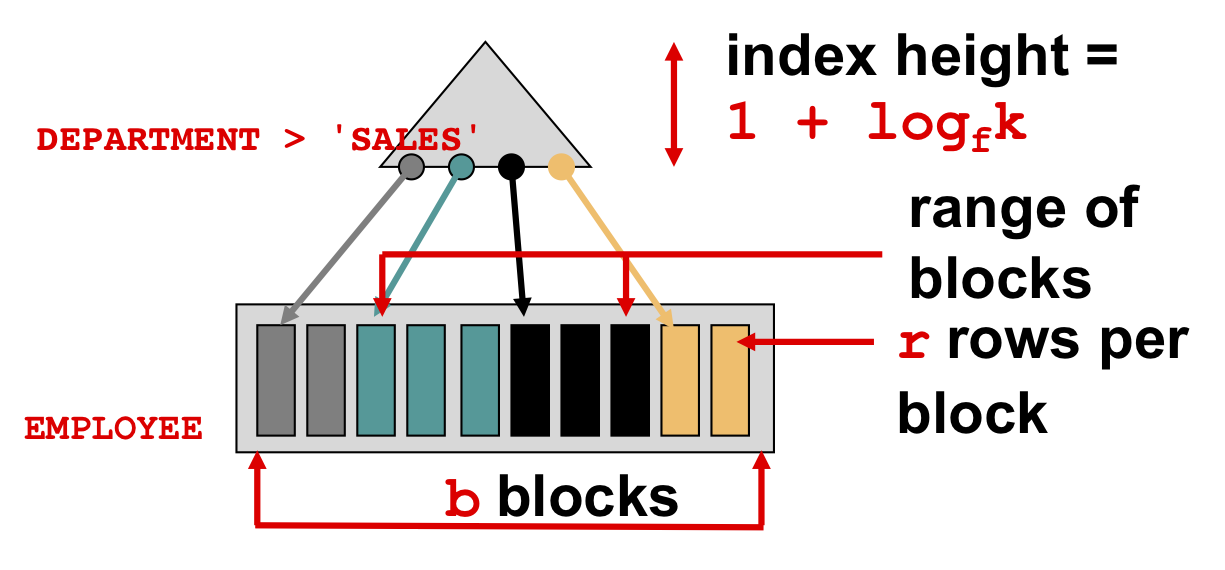
- Cost = 1+logfk + n*b/k read block operations
Quantitative Analysis of Indexing
Outline
Table with not clustered B* tree index
-
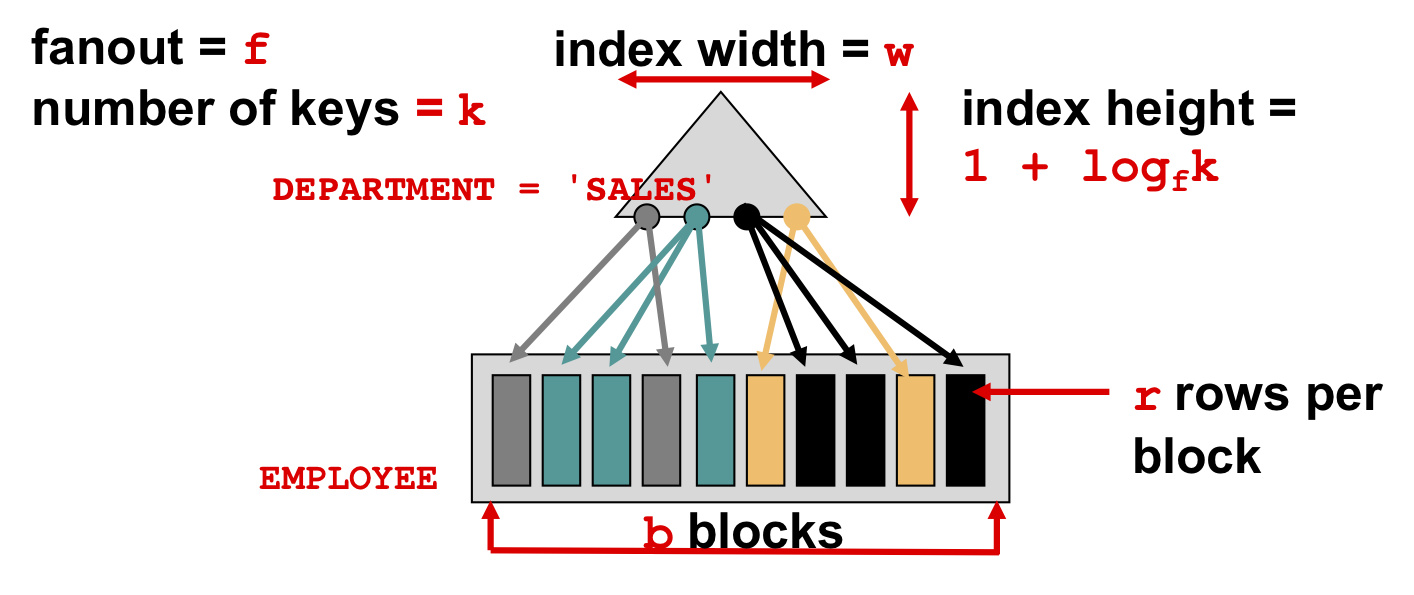
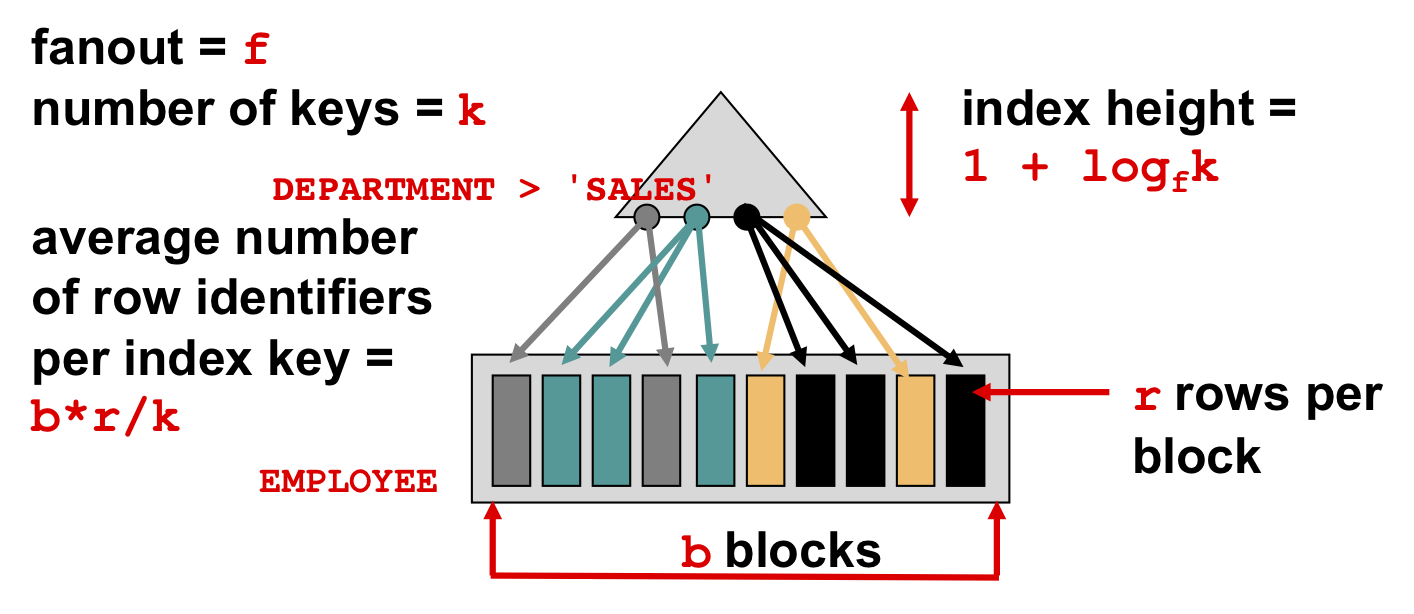
- Total number of row identifiers per index key =
- total number of rows / total number of keys = b*r/k
- Average number of read block operations to read b*r/k rows =
(the worst case+the best case)/2 = (b*r/k +(b*r/k)/r)/2
- =(b*r/k + b/k)/2 = b*(r+1)/(2*k) ≈ b*r/(2*k)
Table with not clustered B* tree index
- Full scan with an equality condition on an index key
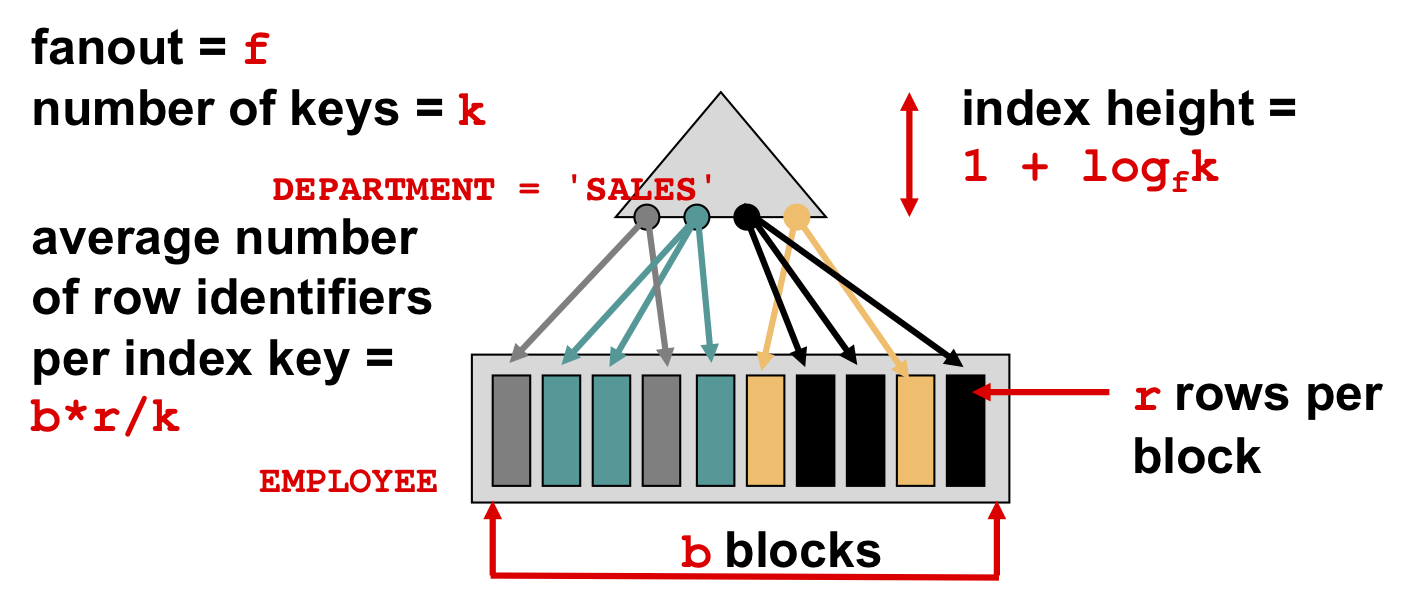
- Cost = ttraverse index + tread data blocks =
- 1+logfk + (b*r/k + b/k)/2
Table with not clustered B* tree index
- Full scan with a range condition on an index key where n is a total number of index keys that satisfy a range condition
- Cost = ttraverse index + tread data blocks =
- 1+logfk + n*((b*r/k + b/k)/2)
References
- Ramakrishnan R., J. Gehrke Database Management Systems, chapters 8.1-8.3
- Lightstone, S., Teorey T., Nadeau T., Physical Database Design, The Database Professional's Guide to Exploiting Indexes, Views, Storage, and More, Morgan Kaufmann Publishers, 2007, chapter 4