Denormalizations
Outline
Simplifications
- Simplification of a conceptual schema is performed in the following four steps:
- Elimination of multivalued attributes
- Elimination of association classes
- Elimination of link attributes
- Elimination of many-to-many associations
- An outcome of simplification is a conceptual schema that contains only one-to-many and one-to-one associations, qualifications, and generalizations
- A simplified conceptual schema is an intermediate form of design between a conceptual schema and the relational schemas
Elimination of multivalued attributes
- Elimination of multivalued attributes is performed in the same way as in a process of logical design
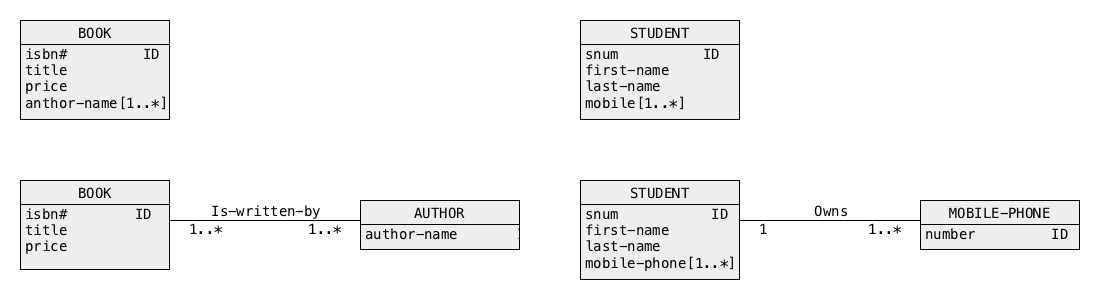
- The values of multivalued attribute are promoted to objects
- A multivalued attribute is replaced with a class of objects and either one-to-many or many-to-many association depending on the semantics of a multivalued attribute
- A new class is described by a single valued attribute with the same name as multivalued attribute
Elimination of link attributes
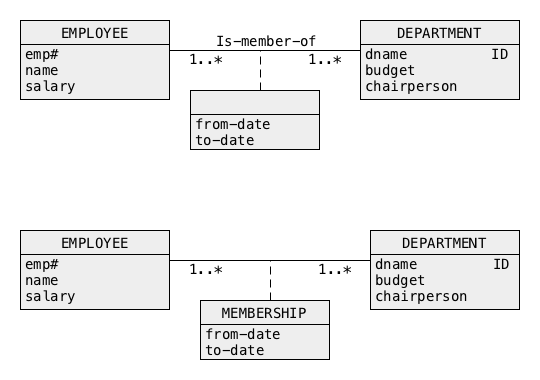
- Elimination of link attributes is performed by promotion of link attributes to association classes (to be eliminated in the next step)
Elimination of many-to-many associations
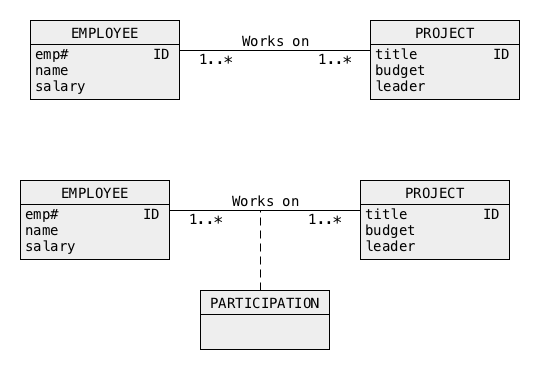
- Many-to-many association is transformed into the same many-to-many association and empty association class that can be eliminated in the next step
Elimination of association classes
- Elimination of association classes is performed by the replacement of many-to-many association and association class attached with one-to-many and many-to-one associations
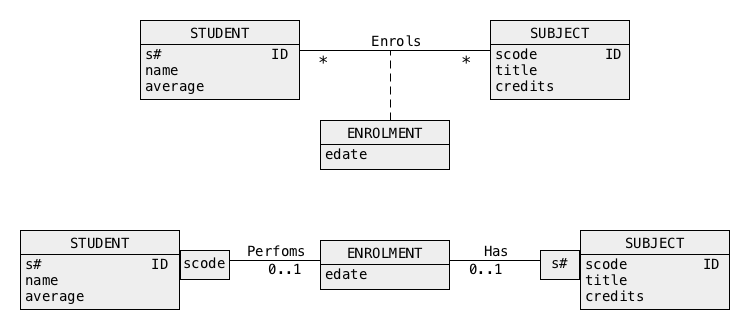
- An association class becomes a class of objects involved in one-to-many and many-to-one associations and qualifications
- In a general case many-to-many association is equivalent to one-to-many and many to many-to-one associations with a class of objects representing many-to-many association
Denormalizations
Outline
Migration of identifiers
- To implement an association we have to copy an identifier from "one" side to "many" side of the association (and NOT the opposite !)
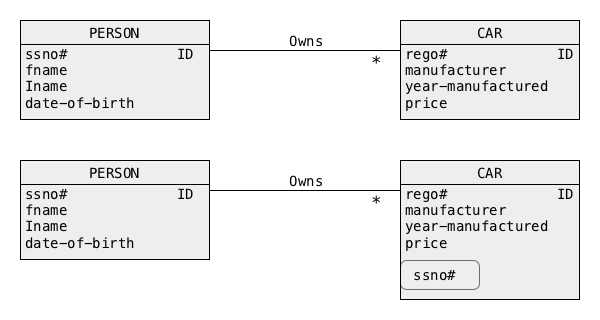
- Performance related observations:
- A long composite identifier allows for longer relational schemas without loosing normalization
- With a long composite foreign key probability that query can be computed without join is higher
- Artificial identifiers (surrogate keys) contribute to join operations
Migration of identifiers
- If an identifier of a class on "many" side of an association is determined through a qualification then both identifier from "one" side and qualification attributes are copied from "one" side to "many" side
of the association (and NOT the opposite !)
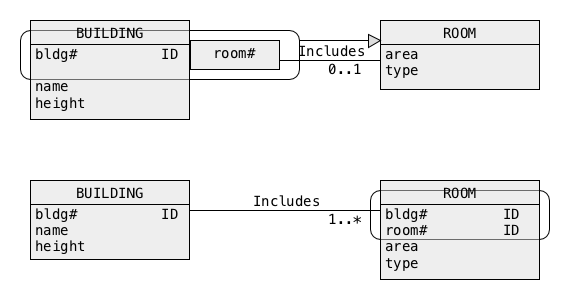
Migration of identifiers
- Advantages
- Migration of identifiers allows for "link-by-value" implementation of associations
- Disadvantages
- Migration of identifiers creates redundancies inevitable for "link-by-value" implementation of associations
- Comments
- "Link-by-reference" is the other implementation of association (object-oriented, object-relational database models)
Denormalizations
Outline
Migration of attributes from "one" to "many" side
- It is always possible to copy an attribute from "one" side of an association to "many" side (and NOT the
opposite) of the association
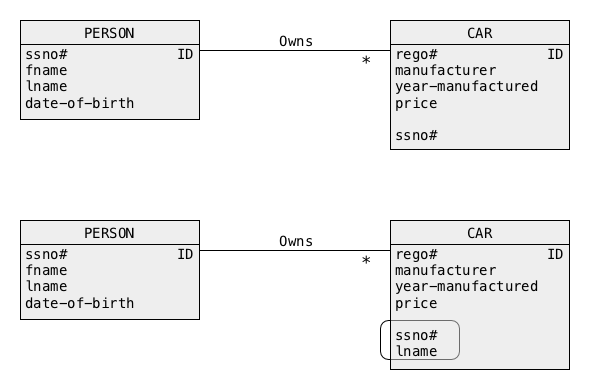
- Performance related observations:
- Copying nonID attributes allows for elimination of join operations in some queries
- Copying nonID attributes destroys normalization and introduces redundancies
- Copying nonID attributes is called as denormalization
Migration of attributes from "one" to "many" side
- Applications
- Find the last names of people who own a car manufactured in
year 2000 - Find how old are the cars owned by Smith
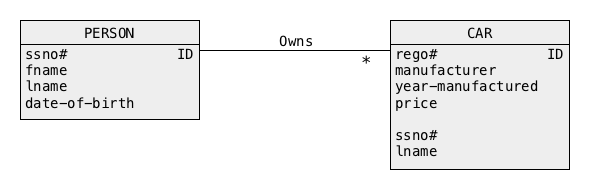
- Find the last names of people who own a car manufactured in
- Performance related observations:
- To process both queries there is no need to join the relational tables PERSON and CAR
- A relational table CAR is extended by a redundant column lname
- If a relational table CAR contains n rows then n * size(lname) extra bytes are required to implement the table
Migration of attributes from "one" to "many" side
- What about normalization ?
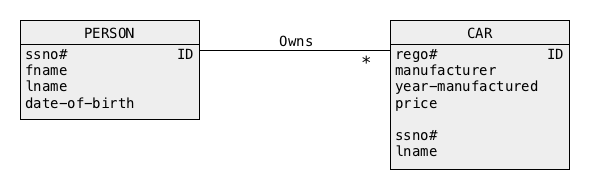
- Functional dependencies:
- CAR:
- rego# → manufacturer
- ...
- rego# → ssno#
- ssno# → lname
- Minimal key: (rego#)
- 2NF because every nonprime attribute is fully functionally dependent on a minimal key
Migration of attributes from "one" to "many" side
- What about normalization ?
- Functional dependencies:
- CAR:
- rego# → manufacturer
- ...
- rego# → ssno#
- ssno# → lname
- Minimal key: (rego#)
- Not 3NF because of transitive functional dependencies rego# → ssno# and ssno# → lname
Migration of attributes from "one" to "many" side
- Example
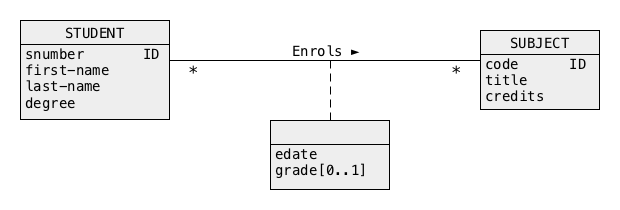
- Assume that we would like to speed up processing of the following classes of queries:
- Find the titles of subjects enrolled by the students who belong to a given degree
- Find the names of degrees taken by the students who enrolled a subject with a give title
- The attributes title and degree must be copied to the same class
Migration of attributes from "one" to "many" side
- After simplification
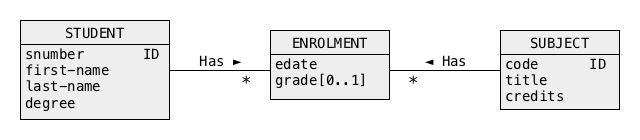
- Many-to-many association described by the link attributes edate and grade[0..1] is replaced with a class ENROLMENT and "one-to-many" association STUDENT Has ENROLMENT and "one-to-many" association SUBJECT Has ENROLMENT
- A class ENROLMENT is described by the attributes edate and grade[0..1]
Migration of attributes from "one" to "many" side
- After implementation of associations
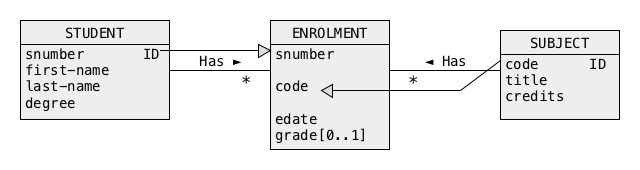
- An identifier snumber of a class STUDENT is copied to a class ENROLMENT
- An identifier code of a class SUBJECT is copied to a class ENROLMENT
Migration of attributes from "one" to "many" side
- After denormalization
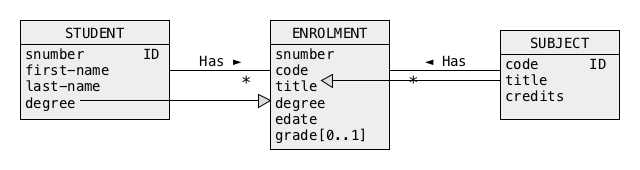
- An attribute degree in a class STUDENT is copied to a class ENROLMENT
- An attribute title in a class SUBJECT is copied to a class ENROLMENT
- Now, the attributes degree and title can be used in the same query without the joins of relational tables
- The design is redundant because the values of atributes degree and title are repeated each time a student enrols a subject