Decompositions
Outline
Horizontal decomposition
- An objective of horizontal decomposition of a class of objects (vertical decomposition of a relational table) is to reduce a size of objects in a class (rows in a relational table)
- For example, we would like to reduce the size of objects in a class EMPLOYEE
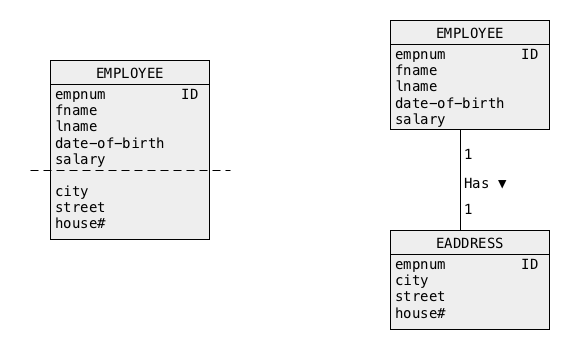
Horizontal decomposition
- Performance related observations
- Horizontal decomposition reduces the amounts of persistent storage needed to implement decomposed classes of objects (relational tables)
- Reduction of object size (row size) speeds up processing of sequential scans of classes of objects (relational tables) because less data blocks are need to store data
- Horizontal decomposition may increase processing time when the values of attributes from disjoint classes of objects (relational tables) are used in the same query; then additional join is required
- Horizontal decomposition does not affect normalization
- After horizontal decomposition insertion of a new object (row) needs two operations and not one like before
Horizontal decomposition
- Sample applications
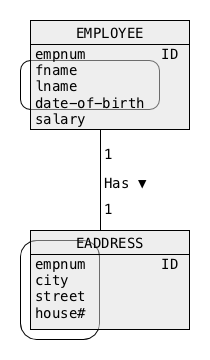
- Queries that benefit from horizontal decomposition
- Find full address (city,street,house#) of an employee identified by a given employee number
- Find the first and the last name of all employees more than 60 years old
- Queries that loose on horizontal decomposition
- Find full address (city,street,house#) of all employees more than 60 years old
- Find the first and the last name of all employees living in a given city
Decompositions
Outline
Vertical decomposition
- An objective of vertical decomposition of a class of objects (horizontal decomposition of a relational table) is to reduce the total number of objects in the classes (rows in the relational tables) obtained after decomposition
- For example, we would like to reduce the total number of objects in a class EMPLOYEE that contains information about employees from finance and personnel departments
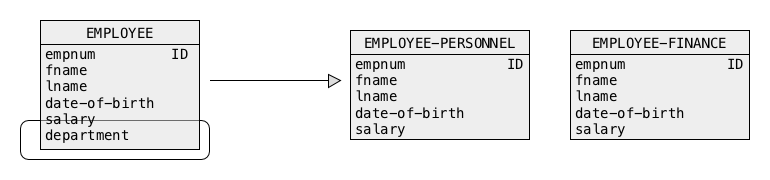
Vertical decomposition
- Performance related observations
- Vertical decomposition reduces the total number of objects accessed by an application
- Reduction of total number of objects (total number of rows) speeds up processing of sequential scans of classes of objects (relational tables)
- Vertical decomposition increases processing time when all objects from the decomposed classes of objects (relational tables) must be accessed; then additional union is required
- Vertical decomposition does not affect normalization
- Vertical decomposition requires replication of code that enforces consistency constraints, e.g. stored procedures/functions or triggers
Vertical decomposition
- Sample applications
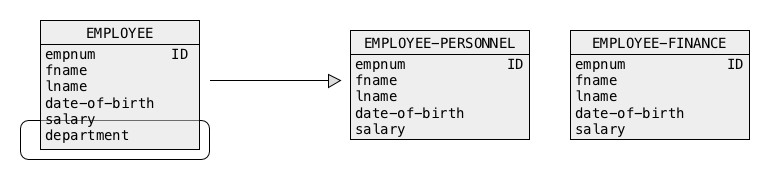
- Queries that benefit from vertical decomposition
- Find a salary of a given employee from finance department
- Find the names of employees from personnel department
- Queries that loose on vertical decomposition
- Find an average salary of employees from both finance and personnel departments
- Find the total number of employees in the given age ranges
Decompositions
Outline
Implementations
- Vertical decomposition of relational tables
- Vertical decomposition can be implemented either through indexing or materialization
- A composite key index can be created on the attributes included in a relational table obtained from horizontal decomposition
- A materialized view can be created to implement a relational table obtained from vertical decomposition
- Horizontal decomposition of relational tables
- Horizontal decomposition can be implemented partitioned relational tables
- Larger Database Management Systems implement partitioned relational tables
- A concept of partitioned relational table is a component of standard SQL