Introduction to Indexing
Outline
Index ? What is it ?
- An index is a data structure that organizes data records on persistent storage to optimize certain kinds of retrieval operations
- An index is used to efficiently retrieve all records that satisfy a search condition on the search key fields of the index
- An index is a function f : K → ℘(idR) where K is set of keys and
- ℘(idR) is a powerset (a set of all sets) of identifiers (addresses) idR of the records in a set R
- Let EMP be a relational table over a relational schema
Employee(enumber, name, department) - Then, Fdepartmentdomain(department) → ℘(idEMP) is a function that maps the names of departments in domain(DEPARTMENT) into the sets of identifiers of rows ℘(idEMP) in relational table EMP
- Fdepartment('Sales') returns the identifiers of all rows where a value of attribute department is equal to 'Sales'
Introduction to Indexing
Outline
Index versus indexed file organization
- An indexed file organization (index organized file) is a function
f : K → ℘(R) where K is a set of keys and ℘(R) is a powerset (a set of sets) of records R - An index maps a value into set of row identifiers
- An index organized file maps a value into a set of records
- A relational table can be indexed or it can be index organized
- An indexed relational table consists of several index(es) created separately from implementation of a relational table itself
- An index organized relational table consists only of implementation of one index where an index key is the same as a relational schema of an index organized table
- Indexing in database systems is transparent to data manipulation and data retrieval operations
- It means that a database system automatically modifies an index and automatically decides whether an index is used for search
Introduction to Indexing
Outline
Primary (unique) index
- A primary (unique) index is an index on a set of attributes equal to primary or candidate key
- A primary index is a function f : K → idR where K is a set of key values and idR is a set of identifiers (physical addresses) of rows in a relational table R
- A primary index maps and index key into a single row identifier (physical address of a row)
- Fenum: domain(enum) → idEMPLOYEE
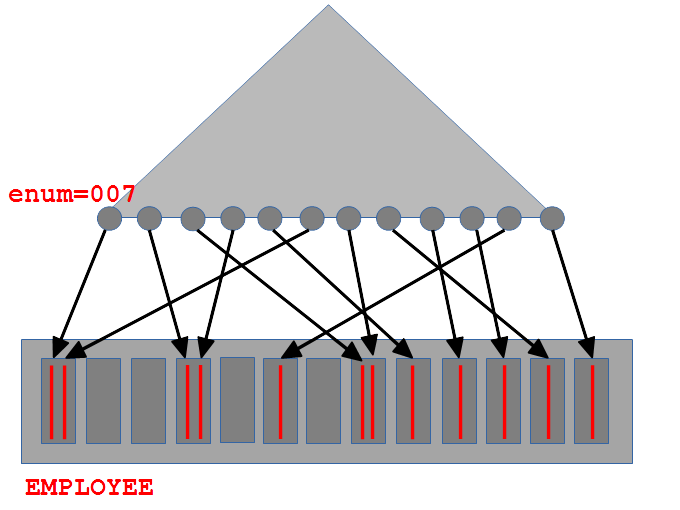
Primary (unique) index
- A primary key in a relational table is always automatically indexed by a database system
- For example, a relational table EMPLOYEE created over a relational schema Employee(enum, name, department) where enum is a primary key has an index automatically created on an attribute (enum)
- For example, a relational table ENROLMENT created over a relational schema Enrolment(snumber,code,edate) where (snumber,code) is a primary key has an index automatically created on a set of attributes (snumber,code)
- An index on (snumber,code) is a composite index
Introduction to Indexing
Outline
Secondary (nonunique) index
- A secondary index is an index which is not primary
- A secondary index is a function f : K → ℘(R) where K is a set of key values and idR is a set of identifiers (physical addresses) of rows in a relational table R
- A secondary index maps and index key into a single row identifier (physical address of a row)
- Fdepartment: domain(department) → ℘(idEMPLOYEE)
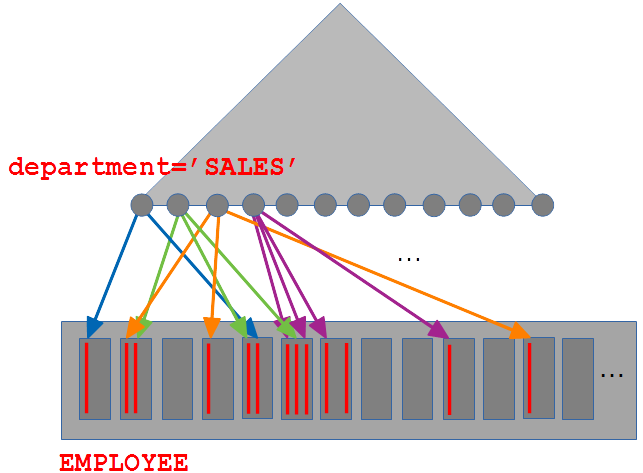
Secondary (nonunique) index
- For example, an index on an attrtibute (name) in a relational table EMPLOYEE created over a relational schema Employee(enum, name, department) is a secondary (nonunique) index
- For example, an index on a set of attrtibutes (name, department) in a relational table EMPLOYEE created over a relational schema Employee(enum, name, department) is a secondary index
- For example, an index on an attribute (snumber) in a relational table ENROLMENT created over a relational schema Enrolment(snumber,code,edate) is a secondary index
- An index on a set of attributes (enum,name) in a relational table EMPLOYEE created over a relational schema Employee(enum, name, department) is still a primary index because (enum,name) is a superkey
Introduction to Indexing
Outline
Clustered index
- A clustered index is an index organized such that the ordering of rows is the same as ordering of keys in the index
- A clustered index is a function f: K → idR where K is a set of keys and idR is a set of row identifiers (addresses) in a relational table R such that f(v) returns row identifier (address) of the first row in a sequence of rows such that a value of attribute K is equal to v
- fdepartment: domain(department) → idEMPLOYEE
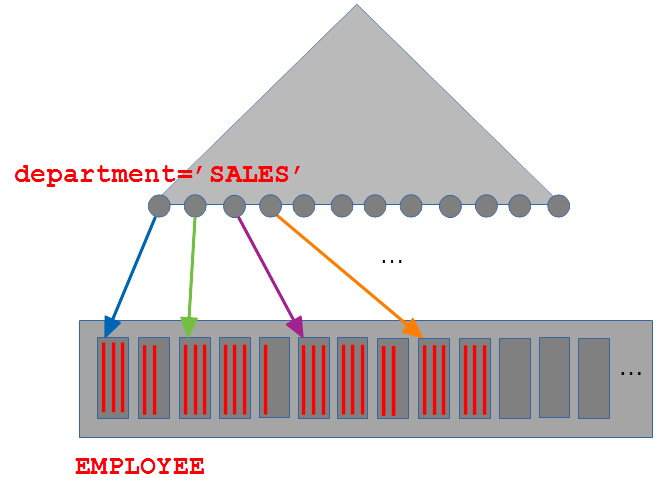
Clustered index
- Every primary index is clustered
- Clustered index provides faster access to data than nonclustered secondary index
- Clustered index has a very negative impact on performance of INSERT and UPDATE SQL statements
- Therefore, clustered indexing should be applied to mainly to read-only data
Introduction to Indexing
Outline
B*-tree index implementation
- B*-tree can be traversed either:
- vertically from root to leaf level of a tree
- horizontally either from left corner of leaf level to right corner of leaf level or the opposite
- vertically and later on horizontally either towards left lower corner or right lower corner of leaf level
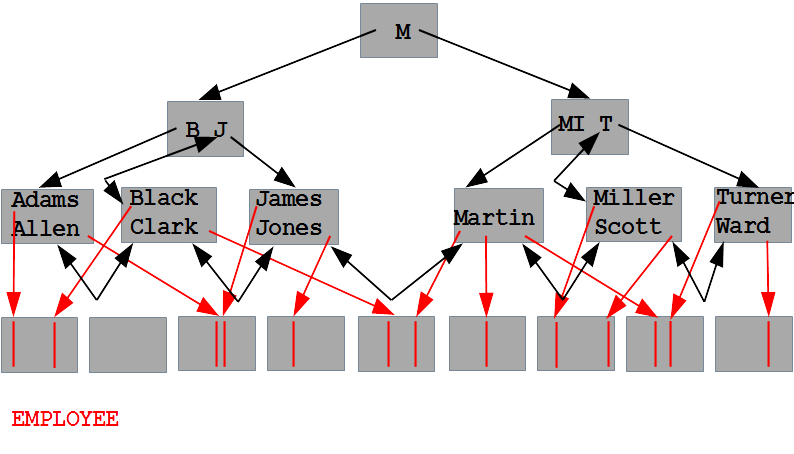
B*-tree index implementation
- The height of B*-tree is a length of path from root node to any of leaf nodes measured either in a number of nodes or edges along the path
- The fanout of B*-tree is an average number of children nodes attached to a non-leaf node
- If B*-tree has the height equal to h and the fanout equal to f then such a tree has fh leaf nodes
- If k is the total number of keys then k = fh
- Hence logf(k) = h
- The height of a tree h = logf(k) + 1
Introduction to Indexing
Outline
Traversals of B*-tree index
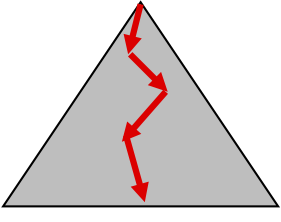
- Vertical traversal
- Vertical traversal passes through B*-tree from the root node to one of the leaf nodes
- The total number of data blocks read during a vertical scan of B*-tree is equal to the height of B*-tree h measured in the number of nonleaf nodes + 1
- The total number of data blocks read during a vertical traversal of B*-tree is equal to logf(k) + 1 where f is a fanout and k is the total number of keys included in the index
Traversals of B*-tree index
- An index on a primary key (enum) in a relational table EMPLOYEE created over a relational schema Employee(enum, name, department, salary) is always built automatically by a database system
- A name of an index is the same as a name of primary key constraint in a relational table EMPLOYEE
- The following queries are processed through a vertical traversal of an index on (enum)
SELECT *
FROM EMPLOYEE
WHERE enum = 007;
SELECT *
FROM EMPLOYEE
WHERE enum = 007 AND department = 'MI6';
SELECT enum
FROM EMPLOYEE
WHERE enum = 007;
Traversals of B*-tree index
- Assume that we created an index on attribute (name) in a relational table EMPLOYEE created over a relational schema
Employee(enum, name, department, salary) - The following queries will be processed through a vertical traversal of an index on (name)
SELECT *
FROM EMPLOYEE
WHERE  name = 'James';
SELECT *
FROM EMPLOYEE
WHERE name = 'James' and department = 'MI6';
SELECT count(*)
FROM EMPLOYEE
WHERE name = 'James'
Traversals of B*-tree index
- Assume that we created an index on the attributes
(name, department) in a relational table EMPLOYEE created over a relational schema Employee(enum, name, department, salary) - The following queries are processed through a vertical traversal of an index on (name, department)
SELECT *
FROM EMPLOYEE
WHERE name = 'James' and department = 'MI6';
SELECT count(*)
FROM EMPLOYEE
WHERE name = 'James' and department = 'MI6';
SELECT *
FROM EMPLOYEE
WHERE name = 'James' and department = 'MI6' and salary > 1000;
Traversals of B*-tree index
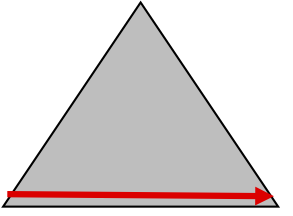
- Horizontal traversal
- Horizontal traveral passes through B*-tree from the leftmost (rightmost) leaf level node to the rightmost (leftmost) leaf level node
- The total number of data blocks read during a horizontal traversal of B*-tree is equal to the total number of leaf level nodes w
- The height of B*-Tree and the total number of leaf level nodes may be obtained from a data dictionary view USER_TABLES after processing of ANALYZE TABLE statement
Traversals of B*-tree index
- The following queries are processed through a horizontal traversal of leaf level of an index on (enum)
SELECT COUNT(*)
FROM EMPLOYEE;
SELECT COUNT(enum)
FROM EMPLOYEE;
SELECT COUNT(name)  /* Only if name IS NOT NULL */
FROM EMPLOYEE;
SELECT enum
FROM EMPLOYEE;
SELECT enum, COUNT(*)
FROM EMPLOYEE
GROUP BY enum;
SELECT enum
FROM EMPLOYEE
ORDER BY enum;
Traversals of B*-tree index
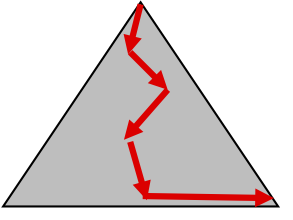
- Vertical and horizontal traversal
- Vertical and horizontal traversal passes through B*-tree from the root node to one of the leaf nodes and later on the leaf nodes towards the rightmost (leftmost) leaf node
- The total number of data blocks read during a vertical and horizontal traversal of B*-tree is equal to logf(k) + 1 + p*w where f is a fanout, k is the total number of keys, w is the total number of leaf level blocks and p is a fraction of w to be traversed
Traversals of B*-tree index
- The following queries can be processed through a vertical traversal and later on horizontal traversal of an index on (enum)
SELECT *
FROM EMPLOYEE
WHERE enum > 300;
SELECT count(*)
FROM EMPLOYEE
WHERE enum < 007;
SELECT *
FROM EMPLOYEE
WHERE enum > 300 and salary > 1000;
Traversals of B*-tree index
- Assume that we created an index on the attributes
(name, department) in a relational table EMPLOYEE created over a relational schema Employee(enum, name, department, salary) - The following queries can be processed through a vertical traversal and later on horizontal traversal of an index on (name, department)
SELECT *
FROM EMPLOYEE
WHERE name > 'James';
SELECT count(*)
FROM EMPLOYEE
WHERE name <= 'James';
SELECT *
FROM EMPLOYEE
WHERE name = 'James' and department > 'MI6';
Traversals of B*-tree index
- Assume that we created a composite key index on the attributes
(name, department) in a relational table EMPLOYEE created over a relational schema Employee(enum, name, department, salary) - The following queries can be processed through a vertical traversal and later on horizontal traversal of an index on (name, department)
SELECT *
FROM EMPLOYEE
WHERE name > 'James' and salary > 1000;
SELECT name, count(*)
FROM EMPLOYEE
WHERE name > 'James' and salary > 1000
GROUP BY name;
SELECT *
FROM EMPLOYEE
WHERE name > 'James' and salary > 1000
ORDER BY name;
Introduction to Indexing
Outline
Hash-based index implementation
- A hash-based index consists of a sequence of primary data blocks and the "buckets" of overflow data blocks linked to the primary data blocks
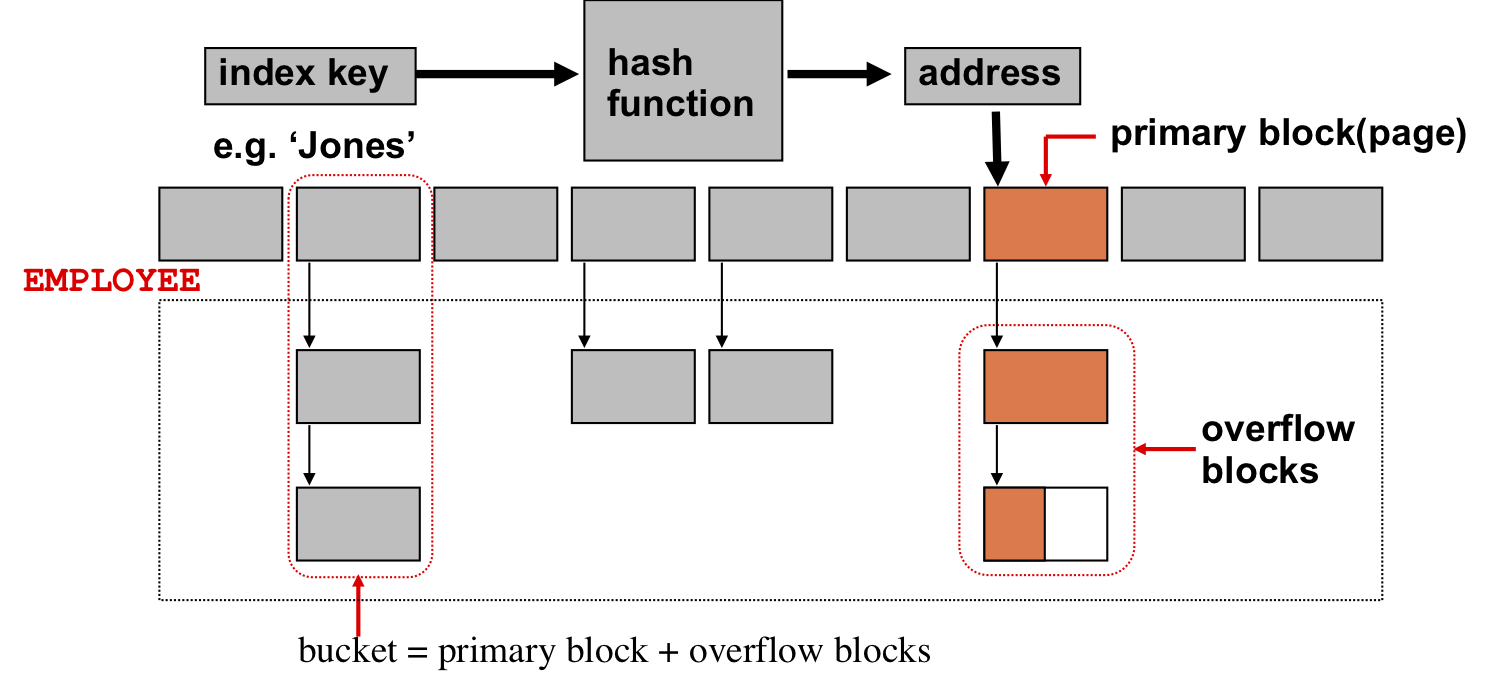
- To insert a row into hash-based index a hash function is computed over a key
- A result of hash function determines a primary block or a "bucket" of overflow blocks that should be used for insertion
Hash-based index implementation
- A hash function has the following properties
- A hash function h does not have an inverse function, for some keys k1, k2, …, kn h(k1) = h(k2) = … = h(kn)
- A result of hash function determines a primary block or a "bucket" of overflow blocks that should be used for insertion
- Quality of hashing depends on how evenly a hash function distributes the records over buckets
- The best quality is achieved if size of each bucket is more or less the same
- A sample hash function: (folding and xor-ing n bits ) mod number-of-buckets
References
- Elmasri R. and Navathe S. B., Fundamentals of Database Systems, Chapter 17 Indexing Structures for Files and Physical Database Design, 7th ed., The Person Education Ltd, 2017