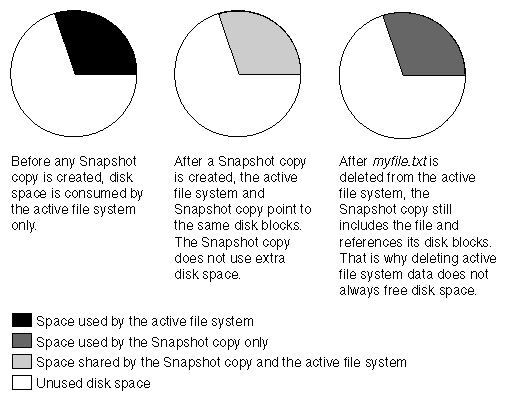
Data ONTAP preserves pointers to all the disk blocks currently in use at the time the Snapshot copy is created. When a file is changed, the Snapshot copy still points to the disk blocks where the file existed before it was modified, and changes are written to new disk blocks.
Disk consumption is minimized by preserving individual disk blocks rather than whole files. Snapshot copies begin to consume extra space only when files in the active file system are changed or deleted. When this happens, the original file blocks are still preserved as part of one or more Snapshot copies. However, in the active file system the changed blocks are rewritten to different locations on the disk or removed as active file blocks entirely. As a result, in addition to the disk space used by blocks in the modified active file system, disk space used by the original blocks is still reserved to reflect the status of the active file system before the change.