Research Interests
My research interests are concerned primarily with
physical properties, particularly mass transfer, in fluids and porous media
such as polymers and foods. It spans
both pure research, studying interactions in fluid mixtures and their effect on
the properties and structure of the system and applied research targeted at
specific, often industry-driven, goals.
At present there are four areas in which these interests are being
pursued:
 Analysis
of trace pollutants in the environment
Dynamic
processes in complex liquids and mixtures
Electromaterials Science
In collaboration with Prof.
A major focus of my work has been the use of ICP as
stationary phases and
membranes or in composite materials, amongst others, to affect separations of complex mixtures.
This is the basis of a new, exciting separations technology. The advantage of
the conducting layer is twofold. Firstly the unique redox
properties may be used to enhance transport of ions across the film - indeed
selective transport of species may be turned on and off and modulated through
electrical stimulation. Secondly the rich diversity of chemical moieties that
may be incorporated into such conducting polymer films as counterions
(or neutral species) enables a wide range of surface chemistries to be
produced. The conducting polymer is able to act as a thin selective passive
layer as well as having inherent conductivity and redox
properties. These advantages make such materials a rich source for novel device
and other applications, such as metal ion separation and recovery. Current projects are focused on metal
recovery and in collaboration with Prof. Doug MacFarlane of
Selected publications:
J. Ding,
J. Wu, D. MacFarlane, W. E. Price, G.G Wallace “ Induction of Titanium reduction
using pyrrole and polypyrrole
in the ionic liquid Ethyl-methyl-imidazolium bis(trifluoromethanesulphonyl)amide.,
“. Electrochemistry Communications, in press, (2007).
J. Ding,
W. E. Price, S. F. Ralph and G. G. Wallace “Electroless
Recovery of Gold Chloride Using Inherently Conducting Polymers’, Polymer International 53,681-687 (2004).
Food Analysis and
Food Processing
Mass transfer is often the rate-limiting step in
extraction from foodstuffs. Experience has been built up in this area over
nearly twenty years measuring the kinetics and equilibrium behaviour
of solvent extraction from foodstuffs such as tea, coffee, citrus fruit and
ginger. In addition, my research interest in tea and coffee processing has
engendered another interest in extraction and analysis of food components, particularly ones
that are bioactive ie have some biological
action. At present there are two
projects in progress.
Figure 1: Isoflavones – an
example family of phytoesotrogens
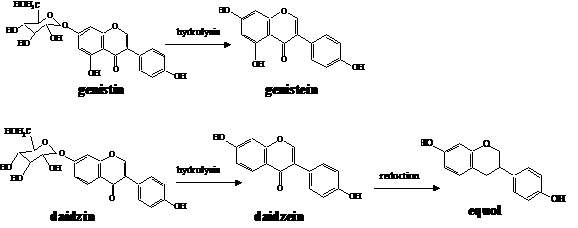
The
first area is studying methods of analysis of phytooestrogens
in foods and the bioavailability of these important compounds in humans. Soy
and linseed products have high phyooestrogens
contents, particularly isoflavanols and ligans. These compounds have been implicated in a number of
studies to have significant health benefits. This work is being carried out in
conjunction with Assoc. Prof.
The second area is that of chemical and physical
changes during the processing of foods. Of particular interest of late have
been studies on the effects of air and osmotic dehydration of temperate and
tropical fruit. This builds on some developments in techniques previously. Osmotic dehydration is used as a
pre-treatment to thermal / air drying to reduce the cost and time for drying
and also sometimes to change the flavour and quality
characteristics of the fruit. One major focus of the current work is on
investigating how the uptake of sugars during the osmotic dehydration treatment
modulates the chemical changes that occur during drying. . In addition, there is another focus aimed at
identifying changes in volatile profile of the food during processing as a
method of quality assurance and looking for markers of undesirable changes
caused by for example, caramelisation or Maillard reaction.
These interests utilises SPME and GC/MS
techniques for flavour analysis as well as HPLC
analysis of carbohydrates.
Selected Publications
M. Ngyuen
and W.E. Price “Air-drying of Banana: influence of
experimental parameters, slab thickness, banana maturity and harvesting season.
“ J.
Food
T. Murray, J. Kang, L. Astheimer and W. E. Price, “Tissue Distribution of Lignans
in Rats in Response to Diet, Dose – Response and Competition with Isoflavones “, Journal
of Agricultural and Food Chemistry, 55(12), 4907-4912, (2007).
T. M. Larkin, W.E. Price and L.
Astheimer “Increased probiotic yogurt or resistant
starch intake does not affect isoflavone
bioavailability in subjects consuming a high soy diet.” Nutrition 23(10) 709-718 (2007).
Analysis of trace pollutants in the environment
A recent project in collaboration
with Prof. Andrea Schaefer of
Selected Publications
J.
Kang, L. A. Hick and W. E. Price, “A fragmentation study of isoflavones in negative electrospray
ionization by MSn ion trap mass spectrometry and
triple quadrupole mass spectrometry.” Rapid Communications in Mass Spectrometry 21, 857-868 (2007).
J.
Kang, L. A. Hick and W. E. Price, “Using calibrational
approaches to compensate for remaining matrix effects in quantitative LC-ESI-MSn analysis of phytoestrogens in
aqueous environmental samples”, Rapid
Communications in Mass Spectrometry, 21,
4065-4072, (2007).
J. Kang, L. A. Hick and W. E. Price , “Simultaneous determination of isoflavones and lignans at trace levels in natural waters and wastewater samples using liquid chromatography/electrospray ionization ion trap mass spectrometry”, Rapid Communications in Mass Spectrometry 20, 2411-2418, (2006).
Dynamics in Complex Liquids and Mixtures
Experimental measurements of dynamic physical
properties of complex liquids and mixtures are important in furthering our
understanding of the structure of the fluid phase and also of mixing and phase
separation phenomena such as detergency and micellisation.
In addition, data such as transport properties as a function of temperature and
pressure is needed for engineering applications. The concept of the hydrophobic
interaction is of great importance in protein folding and stability, membrane
formation through aggregation of biomolecules,
molecular recognition and other phenomena. Hydrophobic effects play an
important part in a variety of solution processes ranging from self-assembly
process in solution,
surfactant micelle formation in aqueous solution and detergency
and other surface phenomena through kinetic solvent effects in aqueous solvent
mixtures to the behaviour of natural gas hydrates.
A recent Dairy Australia funded project where
hydrophobic interactions can play a major role, has concerned the structure and properties
of milk proteins in solution. as-Casein
is a mammalian milk protein which has recently been shown to have
chaperone-like properties. A chaperone
protein is one that prevents self-assembly and uncontrolled aggregation of
other proteins. Work in progress in
collaboration with Prof. John Carver,
Selected publication:
A. Ghahghaei, A. Rekas, W. E. Price and J. A. Carver, “The effect of dextran on subunit exchange of the molecular chaperone αA-crystallin”, Biophysica Biochimica Acta:
Protein Structure, 1774,
102-111, (2007)
P. E. Morgan T. M. Treweek, R. A.
Lindner, W. E. Price and J. A. Carver, “Casein proteins as molecular chaperones” J.
Agric. Food Chemistry¸ 53¸2670-2683, (2005).
Last revised: 24th
January 2008