Persistent Storage Structures
Outline
Storage pyramid
- Action Time in nanoseconds (1 ns = 10-9 second)
- L1 cache reference 0.5
- Branch mispredict 5
- L2 cache reference 7
- Main memory reference 10
- Mutex lock/unlock 25
- Transmission of 2Kb over 1 Gb/s net 20,000 20 microsec
- SSD random read 150,000 150 microsec
- HDD random read 10,000,000 10 millisec
- Send a package over wide area net 150,000,000 150 millisec
Storage pyramid
- CPU registers
- Cache memory
- Main memory
- Solid State Drive (SSD)
- Hard Disk Drive (HDD)
- Optical disk/Magnetic tape
- Shelved optical disk/shelved magnetic tape
Persistent Storage Structures
Outline
Logical model of persistent storage
-
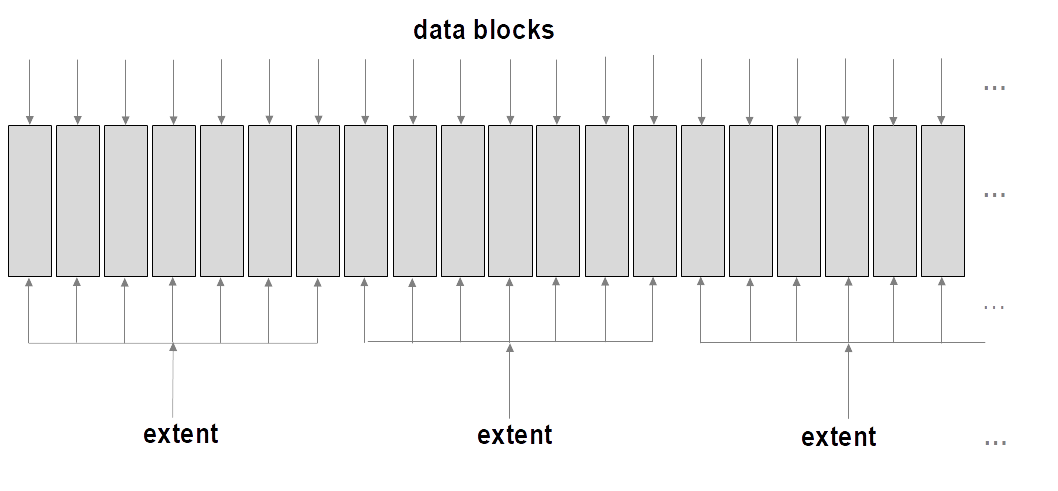
- A data block is a contiguous sequence of 2 Kbytes, or 4 Kbytes, or 8 Kbytes, or 16 Kbytes, or 32 Kbytes
- A data block is identified by block address
- An extent is a contiguous sequence of data blocks
Persistent Storage Structures
Outline
Persistent storage versus transient storage
- A data buffer pool (data cache) is an area of transient storage that contains the blocks transmitted from persistent storage
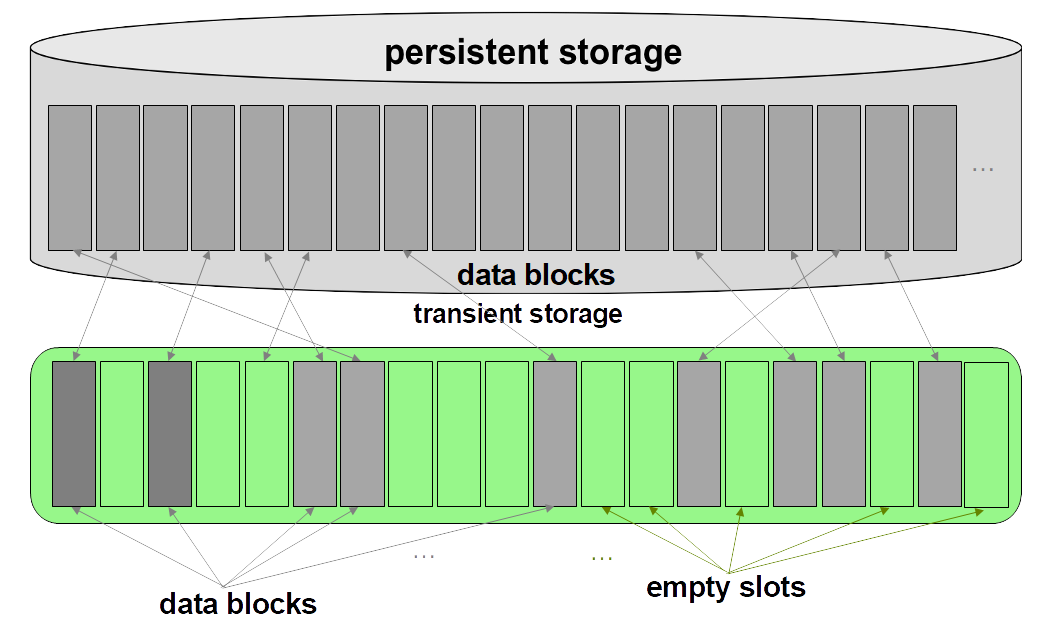
- A data buffer pool is used to reduce a number of transmissions from persistent storage to transient storage and reverse
Persistent storage versus transient storage
- Whenever a data block is read by a database application and such block is not in a buffer pool then it is transmitted from persistent storage
- Whenever a data block is written by a database application then write operation is performed on block in transient storage and such block is not immediately written to persistent storage
- Multiple reads and writes on the same data block are performed on the block located in transient storage
- Hit ratio = (number of read/write operations on data buffer pool)/ (total number of read/write operations)
- In a well tuned system hit ratio ≥ 0.9
- It means that out of 100 read/write operations at least 90 must be performed on data buffer pool
Persistent Storage Structures
Outline
Internal data block format
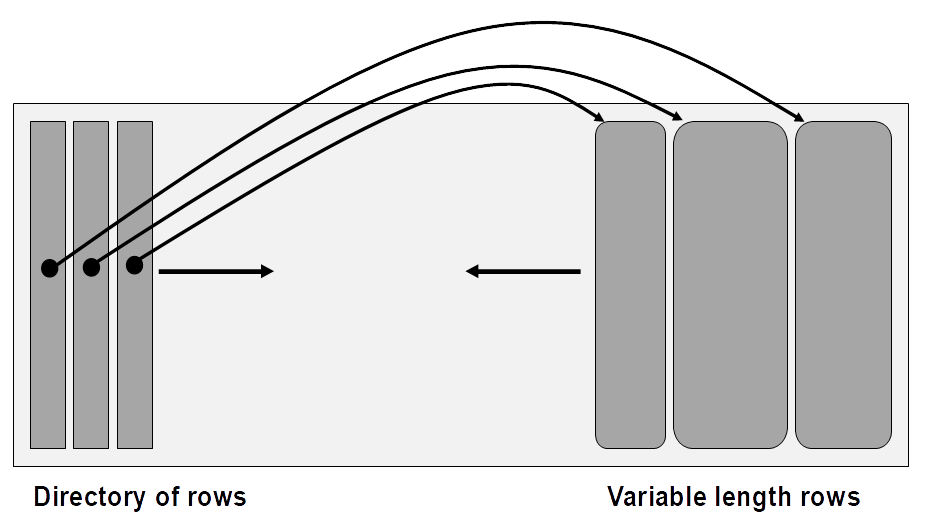
- Row-oriented implementation or relational tables
- Column-oriented implementation of relational tables (discussed later)
Internal data block format
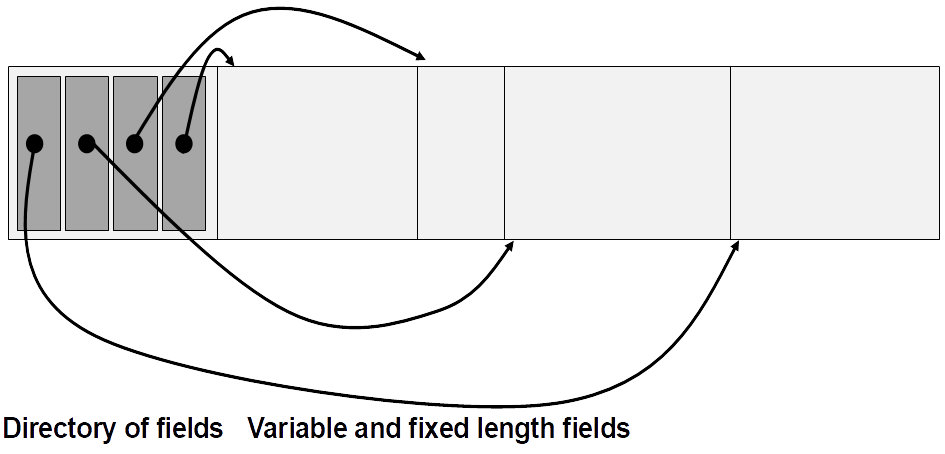
- Directory-oriented implementation of rows in a relational table
Persistent Storage Structures
Outline
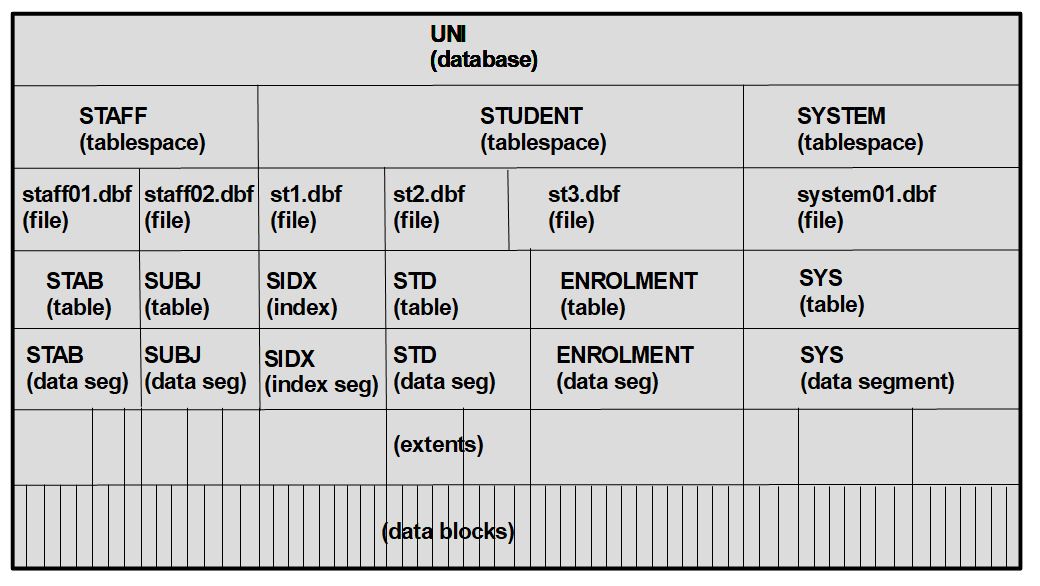
Storage structures
- Data block
- A smallest unit of disk space allocation
- Data block size
- Multiplicity of operating system block size, e.g. 2K, 4K, 8K,16K, 32K
- Extent
- An extent consists of specific number of contiguous data blocks (default 5 blocks, minimum 2 blocks).
- Segment
- A segment consists extents allocated for a specific type of data structure and stored in the same tablespace
- Each relational table is stored in its own data segment, each index is stored in its own index segment, etc
Storage structures
- Tablespace
- A logical storage component of a database. At a physical level a tablespace consists of files. At a logical level a tablespace consist of segments (relational tables, indexes, materialized views, etc)
- Data file
- A physical storage component of a database
Persistent Storage Structures
Outline
Segments
- Data segments
- Tables, materialized views, clusters
- Index segments
- Indexes
- Rollback/UNDO segments
- Segments that contain data blocks updated by database transactions
- Temporary segments
- Segments required for intermediate stages of SQL processing
Persistent Storage Structures
Outline
Tablespaces
- SYSTEM tablespace
- SYSTEM tablespace contains all data dictionary tables
- SYSTEM tablespace contains stored procedures and triggers
- SYSTEM tablespace is automatically created when a database is created
- Performance related observations:
- SYSTEM tablespace must be located on the fastest persistent storage device available
- SYSTEM tablespace must must not share its persistent storage device with other tablespaces
- SYSTEM tablespace must not be used as a user tablespace
Tablespaces
- UNDO tablespace
- UNDO tablespace contains information about old contents of data blocks
- UNDO tablespace is needed to perform rollback operations
- Performance related observations:
- UNDO tablespace should be large enough to allow for rollback of the transactions that modify a lot of data
- A size of UNDO tablespace determines the depth of transaction stack, i.e. a limit in processing of "old" transactions
Tablespaces
- TEMP tablespace
- TEMP tablespace contains temporary segments
- TEMP tablespace is used for sorting, hashing, processing of SQL statements
- TEMP tablespace is automatically created when a database is created
- Performance related observations:
- TEMP tablespace should be large anough to allow for fast processing of sorting and hashing
- TEMP tablespace cannot not be used as user tablespace
Persistent Storage Structures
Outline
Distribution of database objects
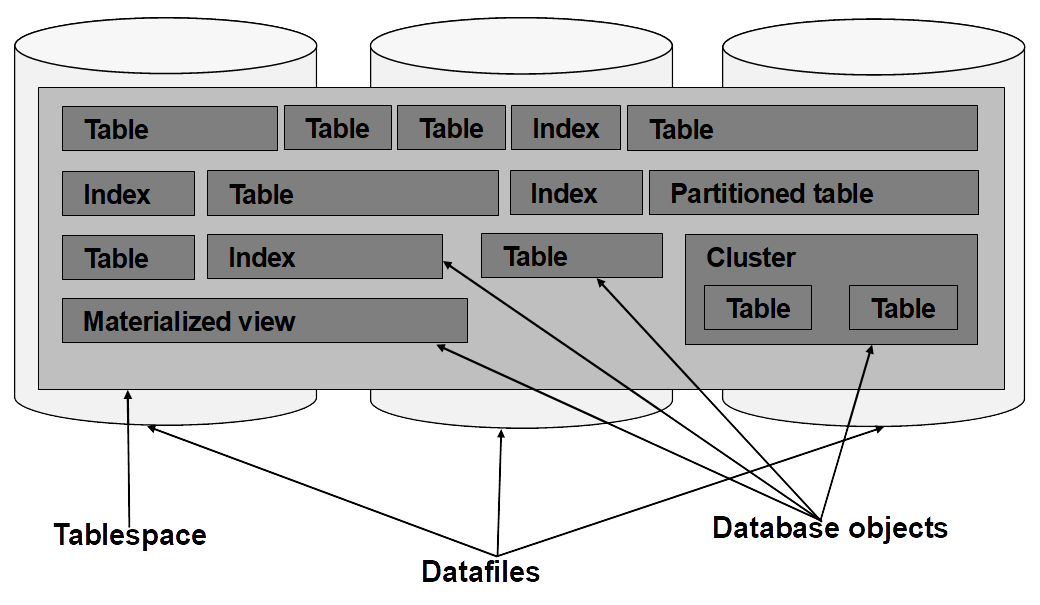
Distribution of database objects
- Performance related observations:
- Distribution of data objects (relational tables, indexes, ..., etc) has a very important impact on performance
- Data objects that are used together should be located on different devices to allow for simultaneous transmission of data from persistent storage to main memory
- For example, two relational tables that are frequently joined should be located on the different persistent storage devices
- Data objects that are the most frequently used should be located on the fastest persistent storage devices
- It is important to consider a balance between a size and frequency of use, for example a small and frequently used relational table should be located on a device that is faster than very large and very rarely used relational table
Persistent Storage Structures
Outline
Manipulations on tablespaces
- Creating tablespaces
CREATE TABLESPACE EXAMPLE
  DATAFILE 'C:\ORACLE\ORA90\DB\EXMP01.DBF'
  SIZE 100M;
ALTER TABLESPACE EXAMPLE
  RENAME TO NEW_EXAMPLE;
- Enlarging tablespaces (1)
ALTER TABLESPACE EXAMPLE
  ADD DATAFILE 'E:\ORACLE\ORADATA\TBS_03.DBF'
  SIZE 3M;
ALTER DATABASE
  DATAFILE 'E:\ORACLE\ORADATA\TBS_03.DBF'
  RESIZE 200M;
Manipulations on tablespaces
- Shrinking tablespaces (1)
ALTER DATABASE
  DATAFILE 'E:\ORACLE\ORADATA\TBS_03.DBF'
  RESIZE 20M;
ALTER TABLESPACE EXAMPLE
  DROP DATAFILE 'E:\ORACLE\ORADATA\TBS_03.DBF'
- Dynamically resizing tablespaces
CREATE TABLESPACE EXAMPLE
  DATAFILE 'C:\ORACLE\ORA90\DB\EXMP01.DBF'
  AUTOEXTEND ON
  SIZE 100M;
ALTER DATABASE
  DATAFILE 'E:\ORACLE\ORADATA\TBS_03.DBF'
  AUTOEXTEND ON;
Manipulations on tablespaces
- Dropping empty tablespaces
DROP TABLESPACE EXAMPLE;
DROP TABLESPACE EXAMPLE INCLUDING CONTENTS;
DROP TABLESPACE EXAMPLE
  INCLUDING CONTENTS
  CASCADE CONSTRAINTS
DROP TABLESPACE EXAMPLE
  INCLUDING CONTENTS
  CASCADE CONSTRAINTS
  AND DATAFILES;
References
- Cookbook, How to create, to manage, and to analyze tablespaces, how to analyze allocation of extents in tablespaces ?
- Cookbook, How to defragment persistent storage at tablespace level, at segment level, and at extent level ?
- Lightstone, S., Teorey T., Nadeau T., Physical Database Design, The Database Professional's Guide to Exploiting Indexes, Views, Storage, and More, Morgan Kaufmann Publishers, 2007, chapter 1
- Kyte, T., Expert Oracle Database Architecture, 9i and 10g Programming Techniques and Solutions, APress, 2005, chapter 10 (Available from "Other Resources" section on Moodle)