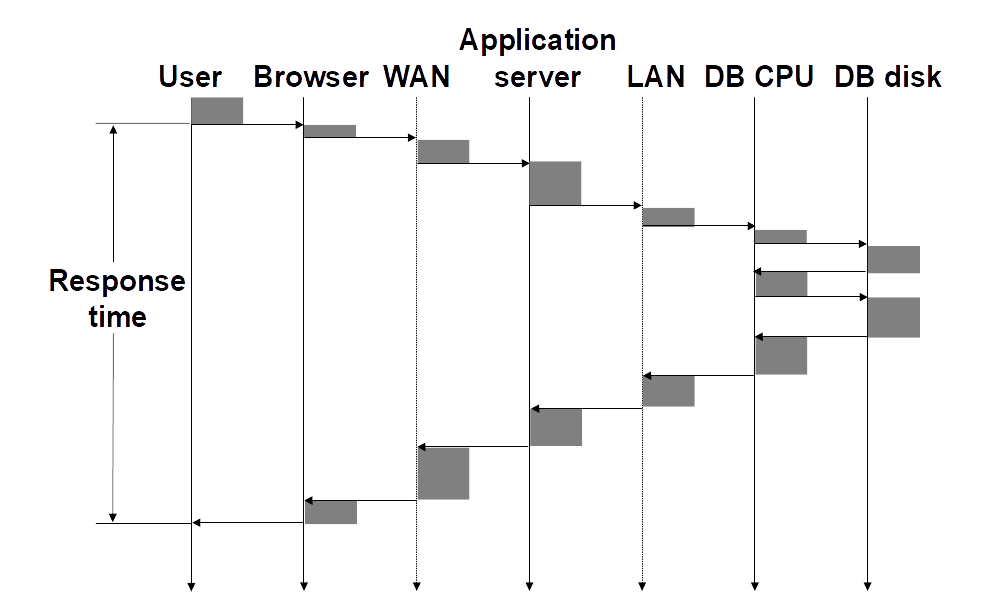
Database performance is the rate at which the DBMS
handles the demand for information
The factors that influence database performance:
(1) Workload
Workload is a combination of online transactions, batch jobs, ad hoc queries, business intelligence queries and
analysis, utilities and system commands directed through DBMS at any given time
Workload defines the demand; it can fluctuate from day to
day, hour to hour, minute to minute; sometimes it can be predicted; at the other times it is unpredictable
(2) Throughput
Throughput defines the overall capability of the system to process data
It is a composite of I/O speed, CPU speed, parallel capabilities of a computer, and efficiency of the operation
system and system software.
Database performance
(3) Resources
Resources are the hardware and software tools like memory, disk space, cache controllers, microcode, etc. available to the system
(4) Optimization
Query optimization is included in DBMS such that up-to- date and accurate database statistics for the query optimizer allow for achieving near optimal implementation of SQL queries
There are other factors that can be optimized like database structures, system parameters, etc.Some optimization aspects are outside the scope and control of relational optimizer, e.g. efficient script coding, proper application design, etc.
(5) Contention
Contention is a situation in which two or more components of a workload are attempting to use a single resource in a conflicting way, e.g. updates of the same data item
DBMS uses locking mechanisms to enable multiple and concurrent users to access and to modify data in a database; using locks guarantee the integrity of data
Database performance tuning is an "activity" of making database applications run "more quickly" "Activity" means an act of making a modification
to hardware or software system properties
"More quickly" means:
higher throughput,
shorter response time,
larger number of users serviced in the same period of time,
larger database loads handled in the same period time,
(3) Start-up costs are high; running costs are low
(4) Render unto server what is due unto server
(5) Be prepared for trade-offs
(1) Think globally; fix locally
Global identification of the problem
A common approach to performance tuning is to look at processor utilization, input/output (I/O) activities, paging,
network traffic, etc.
Local and minimal intervention
A high level of processor utilization does not mean that
we have to buy a new machine, high I/O activity does not mean that we have to buy more persistent storage devices, etc.
A high level of processor utilization may mean that we have to improve a badly written application, high I/O
activity may mean that we have to increase the size of a buffer
(2) Partitioning breaks bottlenecks
"Bottleneck" is a component of the system that limits the overall performance
Partitioning is a technique of reducing the load by dividing it over more resources or by spreading it over time
For example, partitioning of a large relational table and related index into smaller relational tables and smaller
indices, partitioning long transactions into sequences of smaller transactions, partitioning a large SELECT statement
into a combination of smaller SELECT statements
(3) Start-up costs are high; running costs are low
It is relatively more expensive to initiate an operation than repeat it for a longer time
For example, sending 1 Kbyte across a network is only a bit more expensive then sending 1 byte packet or reading one
data block takes more or less the same time as reading entire group of adjacent data blocks
Achieve the objective with the fewest possible start-ups
For example, keep connections to a database server, keep query execution plans, keep frequently used data blocks in
transient memory, etc.
(4) Render unto server what is due unto server
A typical dilemma is who suppose to do a job: client or server ?
The allocation of work between the database system (the server) and the application program
(the client) may have a decisive impact on performance
For example, evaluation of consistency constraints that do not need access to a database should be performed at
the client side, larger tasks performed on the server side reduce amount of data transmitted over a network
(5) Be prepared for trade-offs
Increased performance requires an appropriate combination of transient and persistent memory and computational resources,
For example, more transient memory invested in data buffer caches reduces the total number of transmissions from persistent memory and leaves less memory for storing query execution plans and data dictionary caching
Indexing speeds up query processing and delays updates, deletions, and insertions
Partitioning speeds up processing of one class of queries and delays the others
Clustered systems , main memory, GPU, and MVN database systems
References
D. Shasha and P.Bonnet Database Tuning Principles, Experiments, and Troubleshooting
Techniques, Morgan Kaufmann, 2003, chapter 1, (closed collection in UoW Library)
G. Harrison Oracle Performance Survival Guide, Prentice Hall, 2009, chapter 1
L. Nossov, H. Ernst, V. Chupis, Formal SQL Tuning for Oracle Databases, Springer, 2018
S. R. Alapati, Oracle 12c Performance Tuning Recipes, A Problem-Solution Approach, Apress, 2014