Functional dependencies
Outline
Functional dependency ? What is it ?
- Let R = ( A1, ..., An) be a relational schema (a header of relational table) and let X, Y be the nonempty subsets of R
- We say that a functional dependency X → Y is valid in a relational schema R if
- for any contents of a relational table R, it is not possible that R has two rows that agree in the components for all attributes in a set X yet
- disagree on one or more component for the attributes in a set Y
- Examples
- A warehouse is located at exactly one address: warehouse → address
- An address is related to exactly one warehouse: address → warehouse
- At a warehouse, the parts of the same sort have only one total quantity:
warehouse,part → quantity - A car has one owner: registration → driving license
- A student has one first name and one last name and one date of birth:
student-number → first-name, last-name-date-of-birth
Functional dependency ? What is it ?
- More examples
- An employee belongs to one department:
employee-number → department-name - A manager manages one department: manager-number → department-name
- An employee has one manager: employee-number → manager-number
- A student enrols a subject one time:
student-number,subject-code → enrolment-date - An employee is located in one building in one office:
employee-number → building-number, office-number - An office in a building hosts one employee:
building-number, office-number → employee-number - An office in a building at a campus hosts one employee:
campus-name,building-number, office-number → employee-number - A department has one manager: department-name → manager-number
- A department is located in one building: department-name → building-number
- A department has one manager and it is located in one building:
department-name → manager-number,building-number
- An employee belongs to one department:
Functional dependency ? What is it ?
- How to discover the functional dependencies in a relational table ?
- Is it possible to discover the functional dependencies in a relational schema (a header of relational table) R(A, B, C, D, E) ?
- Of course it is impossible to do it because we do not know the semantics (the meanings) of the names: R, A, B, C, D, E
- To discover the functional dependencies in a relational table we must use the semantics of a relational table name and the names of attributes
- For example consider a relational schema (a header of relational table) TRIP(rego#, licence#, tdate) of a relational table that contains information about the trips made by the drivers (licence#) who used the trucks (rego#) on a given day (tdate)
- Can a truck be used only one time ? If yes then rego# → tdate
- Can a driver make only one trip ? If yes then licence# → tdate
- Can a driver use more than one truck ? If no then licence# → rego#
- Can a truck be used by more than one driver ? If no then rego# → licence#
- And so on ...
Functional dependencies
Outline
Functional dependencies versus classes of objects
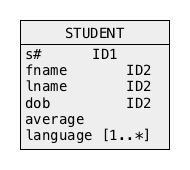
- A class of objects STUDENT
- validates (satisfies) the following functional dependencies:
s# → fname
s# → lname
s# → dob
s# → average
fname, lname, dob → s#
fname, lname, dob → average
Functional dependencies versus classes of objects
- The functional dependencies:
s# → fname
s# → lname
s# → dob
s# → average
are equivalent to a functional dependency
s# → fname, lname, dob, average - The functional dependencies
fname, lname, dob → s#
fname, lname, dob → average
are equivalent to a functional dependency
fname, lname, dob → s#, average
Functional dependencies
Outline
Functional dependencies versus associations
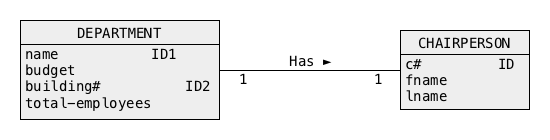
- The classes of objects DEPARTMENT and CHAIRPERSON and association Has
- validate (satisfy) the following functional dependencies:
name → budget, building#, total-employees
building# → name, budget, total-employees - c# → fname, lname
- name → c#, fname, lname
building# → c#, fname, lname
c# → name, building#, budget, total-employees
Functional dependencies versus associations
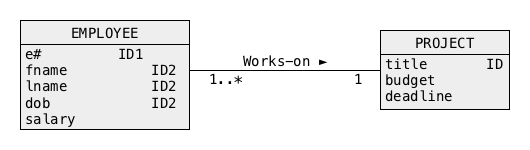
- The classes of objects EMPLOYEE and PROJECT and association Works-on
- validate (satisfy) the following functional dependencies:
e# → fname, lname, dob, salary
fname, lname, dob → e#, salary - title → budget, deadline
- e# → title, budget, deadline
- fname, lname, dob → title, budget, deadline
Functional dependencies versus associations
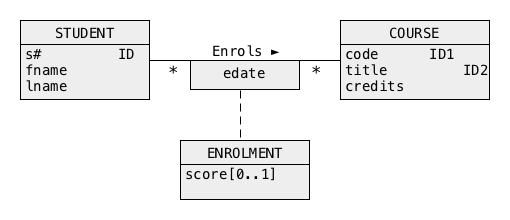
- The classes of objects STUDENT and COURSE and association Enrols
- validate (satisfy) the following functional dependencies:
s# → fname, lname - code → title, credits
title → code, credits - s#, code, edate → score
s#, title, edate → score
Functional dependencies
Outline
Derivations of functional dependencies
- Consider a relational schema (a header of relational table)
EMPLOYEE(e#, ename, department, address, chairperson) - If e# → ename and e# → department then e# → ename, department
- If e# → department and department → address then e# → address
- If e# → department and department → chairperson then
e# → chairperson - If e# → department then e#, ename → department
- If e#, ename → department then e#, ename, address → department
- It is always true that e# → e#
- Functional dependency e# → e# is called as a trivial functional dependency
- It is always true that e#, ename → e#
- A functional dependency e#, ename → e# is also called as a trivial functional dependency
Derivations of functional dependencies
- A trivial functional dependency is a functional dependency that is always true no matter what its left and right hand sides are
- For example,
e# → e#,
department → department
e#, ename → e#,
e#, ename, department → e#, department,
and so on
Derivations of functional dependencies
- Consider a relational schema R(A, B, C)
- It is always true that A → A
- It is always true that A, B → A
- It is always true that A, B, C → A
- If A → B then A, C → B
- If A → B, C then A → B and A → C
- If A → B and B → C then A → C
Functional dependencies
Outline
Armstrong axioms
- Let R = (A1, ..., An) be a relational schema (a header of relational table) and
let X, Y, Z be the nonempty subsets of {A1, ..., An} - (i) If Y ⊆ X then X → Y (reflexivity axiom)
- (ii) If X → Y then X, Z → Y, Z (augmentation axiom)
- (iii) If X → Y and Y → Z then X → Z (transitivity axiom)
- The axioms (i),(ii), and (iii) form a minimal and complete set of axioms
Functional dependencies
Outline
Other inference rules
- Let R = (A1, ..., An) be a relational schema (a header of relational table) and
let X, Y, Z be the nonempty subsets of {A1, ..., An} - If X → Y and X → Z then X → Y, Z (union rule)
- If X → Y and W, Y → Z then W, X → Z (pseudotransitivity rule)
- If X → Y and Z ⊆ Y then X → Z (decomposition rule or reduce right hand side rule)
- If X → Y then X, Z → Y (extend left hand side rule)
Functional dependencies
Outline
Using inference rules
- Let R = (A, B, C) be a relational schema
- Given set of functional dependencies F = {A → B, B → C} valid in R
- Is it true that A → C ?
- If A → B and B → C then application of transitivity axiom provides A → C
Using inference rules
- Let R = (A, B, C) be a relational schema
- Given set of functional dependencies F = {A → B, C} valid in R
- Is it true that A → B and A → C ?
- Reflexivity axiom provides B, C → C
- If A → B, C and B, C → C then transitivity axiom provides A → C
- Reflexivity axiom provides B, C → B
- If A → B, C and B, C → B then transitivity axiom provides A → B
Using inference rules
- Let R = (A, B, C) be a relational schema
- Given set of functional dependencies F = {A → B, A → C} valid in R
- Is it true that A → B, C ?
- If A → B then augmentation axiom provides A → A, B
- If A → C then augmentation axiom provides A, B → B, C
- If A → A, B and A, B → B, C then transitivity axiom provides A → B, C
Using inference rules
- Let R = (A, B, C) be a relational schema
- Given set of functional dependencies F = {A → B} valid in R
- Is it true that A, C → B ?
- Reflexivity axiom provides A, C → A
- If A, C → A and A → B then transitivity axiom provides A, C → B
Using inference rules
- A relational schema STUDENT(s#, fname,lname, dob, average) validates (satisfies) the following functional dependencies:
s# → fname
s# → lname
s# → dob
s# → average
fname, lname, dob → s#
fname, lname, dob → average - We proved that if A → B and A → C then A → B, C
- Hence,
s# → fname, lname, dob, average and ... - fname, lname, dob → s#, average
- Note, that both functional dependencies cover entire relational schema and no other functional dependencies that do not cover entire relational schema validate in the schema e.g. fname → s#
References
- T. Connoly, C. Begg, Database Systems, A Practical Approach to Design, Implementation, and Management, Chapter 14.4 Functional Dependencies, Chapter 15.1 More on Functional Dependencies, Pearson Education Ltd, 2015