Cluster Computing
Outline
Computer Cluster
- What is a computer cluster ?
- A computer cluster is a collection of computers (also called as nodes) connected through high speed local are network that work together to simulate a single much more powerful computer system
- Each node in a computer cluster is controlled by its own operating system
- Each node in a computer cluster performs a different version of the same task
- A difference between computer cluster and computer grid is such that the nodes in a computer grid perfrom different tasks
- An architecture of computer cluster ranges from a simple two-node system connecting two personal computers to a supercomputer with a cluster architecture
Computer Cluster
- Computer clusters are used to speed up computing through shared nothing (sharding) partitioning of data and parallelization of data procesing on the nodes of a cluster
- Computer clusters provide high availability through automatic replacement of a failed node with a replica node
- Advantages of computer clusters: faster processing speed, larger storage capacity, better data integrity, greater reliability and wider availability of resources
- A Linux cluster is a collection of connected computers that can be viewed and managed as a single system
- A sample computer cluster: 54 regular compute nodes (with two 32-Core Intel 8358 processors, 1.6TB of local NVME storage and 512GB of memory each) and 5 GPU nodes with two 24-Core AMD EPYC 7413 processors, eight A100 GPU cards, 960GB of local storage and 512GB of memory each
Computer Cluster
- What is a cluster computing ?
- Cluster computing is the process of sharing the computation tasks among multiple computers included in a computer cluster
- Advantages of cluster computing: cost efficiency, processing speed, expandability, high availability of resources
- At the moment cluster computing is an attractive paradigm for processing large scale science, engineering and commercial applications
- Cluster computing requires the specialized algorithms like load balancing, resource sharing and resource scheduling for optimization of data processing
- Cluster computing is an attractive alternative to data processing on large parallel supercomputers
- The simplest configuration of nodes for cluster computing consists of a mater node and slave nodes
Cluster Computing
Outline
Big Data
- What does Big Data mean and how big is Big Data ?

- Big Data is so big that it cannot be stored on the persistent storage devices attached to a single computer system
- Big Data may also mean an infinite amount of data
Big Data
- What are the sources of Big Data ?
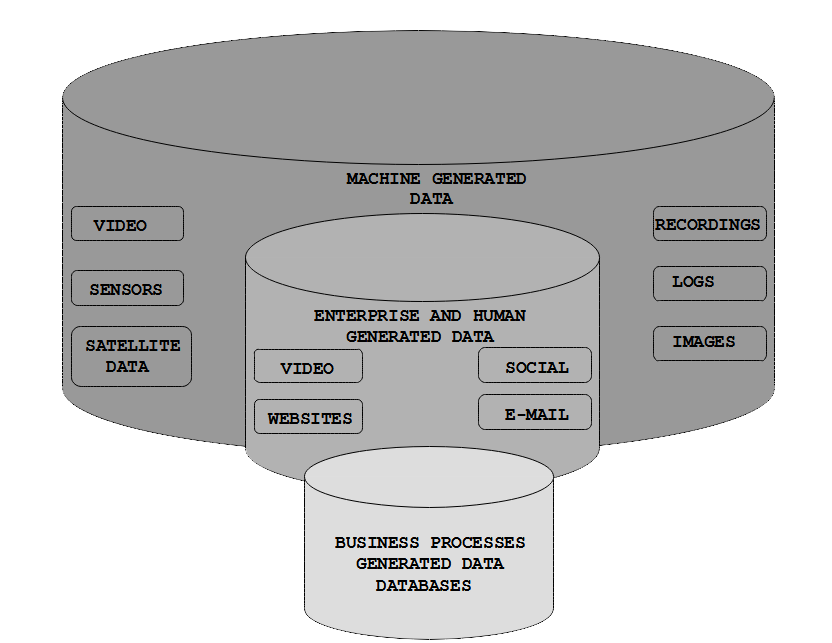
Big Data
- Big Data is characterized by so called 3V features:
- Volume: e.g., billions of rows ? millions of columns
- Variety: Complexity of data types and structures
- Velocity: Speed of new data creation and growth
- Additional Vs:
- Veracity: Ability to represent and process uncertain and imprecise data
- Value: Data is the driving force of the next-generate business
- Viability: Benefits we can potentially have from data analysis
- There are many, many other Vs, the largest number of Vs I found on Web was 42 !
- Vagueness: The meaning of found data is often very unclear, regardless of how much data is available
- Validity: Rigor in analysis is essential for valid predictions where data is the driving force of the next-generate business
- Vane: Data science can aid decision making by pointing in the correct direction
- ... and many, many others ... :)
Big Data
- Examples of Big Data:
- Clickstream data
- Call centre data
- E-mail and instant-messaging
- Sensor data
- Unstructured data
- Geographic data
- Satellite data
- Image data
- Temporal data
- and more ...
Cluster Computing
Outline
Traditional Data Architectures
- Data warehousing technologies

Traditional Data Architectures
- The strength of traditional data architectures:
- Centralised governance of data repositories
- Light-fast inquires performed regularly in daily business
- Optimisation for OLTP and OLAP
- Security and access control
- Fault-Tolerance and backup
- The challenges for traditional data architectures:
- New types of data such as unstructured data and semi-structured data
- Increasingly large amounts of data flowing into organisations
- New computational paradigms use non-traditional NoSQL databases to rapidly mine and analyse very large data sets
- Increasing cost of storing and analysing the large amounts of data
- Increasing use of data analytics, which requires significant storage and processing capabilities
Traditional Data Architectures
- A sample Data Lake architecture

Traditional Data Architectures
- Hardware for Big Data has two scalability dimensions

Cluster Computing
Outline
Meet Hadoop !
- Hadoop, in terms of its developers, is a project that develops open-source software for reliable, scalable, distributed computing
- Features of Hadoop
- Capability to handle large data sets, e.g. simple scalability and coordination
- File size range from gigabytes to terabytes
- Can store millions of those files
- High fault tolerance
- Supports data replication
- Supports streaming access to data
- Supports batch processing
- Supports interactive, iterative and stream processing
- Implements a data consistency model of write-once-read-many access model
- Runs on commodity hardware, not high-performance computers
- Inexpensive
- It can be deployed on premises or in the cloud
Meet Hadoop !
- Core components of Hadoop



Hadoop Ecosystem
- Hadoop ecosystem

Commercial Hadoop Landscape
- Commercial Hadoop landscape

Meet Hadoop !
- Master-slave architecture of Hadoop clusters

Meet Hadoop !
- Hadoop clusters can support up to 10,000 server and receives near-to-linear scalability in computing power
- A typical Hadoop cluster consists of:
- A set of master nodes (servers) where the daemons supporting key Hadoop frame-works run
- A set of worker nodes that host the storage (HDFS) and computing (YARN) work
- One or more edge servers, which are used for accessing the Hadoop cluster to launch applications
- One or more relational databases such as MySQL for storing the metadata repositories
- Dedicated servers for special frameworks such as Kafka
Meet Hadoop !
- Hadoop also supports the pseudo-distributed mode
- All HDFS and YARN daemons running on a single node.
- Highly simulates the full cluster
- Easy for beginner's practice
- Easy for testing and debug
- Our lab setting is the pseudo-distributed mode
- The single node is Ubuntu 22.4 Virtual Machine (VM)
Cluster Computing
Outline
Big Data on Database Clusters
- A database cluster is a collection of databases that is managed by a single instance of a running database server
- A very large database in a database cluster is partitioned over a number of smaller databases each located on a separate node of a computer cluster
- Database clustering requires replication and sharding
- Database clustering improve performance, availability, and scalability
- The classes of database system that allow for database clustering:
- NoSQL systems: MongoDB, RavenDB, Cassandra, Amazon Aurora, ...
- NewSQL systems: ClustrixDB, NuoDB, CockroachDB, Pivotal GemFire XD, Altibase, MemSQL, VoltDB, ...
- Improved OldSQL systems: Oracle RAC, SQL Server (Windows server Failover Cluster), DB2 Cluster, PostgreSQL, MySQL Cluster, ...
Cluster Computing
Outline
Big Data on Kubernetes
- Kubernetes (K8) is a container or microservice platform that orchestrates computing, networking, and storage infrastructure workloads
- in a plain language Kubernetes is an orchestration platform to manage any containerized application
- A Kubernetes cluster consists of a single master node and potentially multiple corresponding worker nodes
- The benefits of Kubernetes:
- horizontal scaling,
- automated rollouts and rollbacks,
- service discovery and load balancing,
- storage orchestration,
- self healing,
- batch execution,
- automatic binpacking
References
- White T., Hadoop The Definitive Guide: Storage and analysis at Internet scale, O'Reilly, 2015 (Available through UOW library)
- Vohra D., Practical Hadoop ecosystem: a definitive guide to Hadoop-related frameworks and tools, Apress, 2016 (Available through UOW library)
- Aven J., Hadoop in 24 Hours, SAMS Teach Yourself, SAMS 2017
- Alapati S. R., Expert Hadoop Adiministration: Managing, Tuning, and Securing Spark, YARN and HDFS, Addison-Wesley 2017