Conceptual Modeling
Outline
Methodology
- Input: Specification of the requirements (usually a natural language description of a database domain)
- Tools: Object Modeling graphical notation
- Methods: Systematic transformation of individual components of specification of requirements into the components of Object Modeling notation
- Output: Conceptual schema - simplified object class diagram
Methodology
- The transformations of specifications are performed in the following sequence of steps:
- Step 1: Creating classes of objects
- Step 2: Creating associations and association classes
- Step 3: Creating attributes and link attributes
- Step 4: Creating identifiers
- Step 5: Creating qualifications
- Step 6: Creating generalizations
Conceptual Modeling
Outline
Example 1
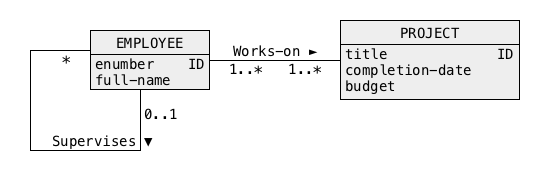
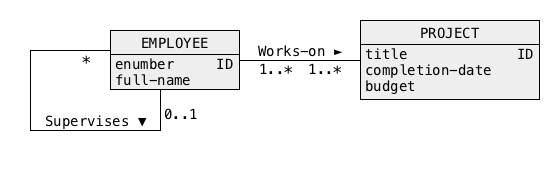
- An objective is to create a conceptual schema of a small database that contains information about employees and projects
- A detailed specification is the following:
- A group of employees works on the projects
- Some of employees supervise other employees
- An employee is described by an employee number and full name
- A project is described by a project title, completion date and budget
- Employees are identified by their employee numbers and projects are identified by titles
Example 1
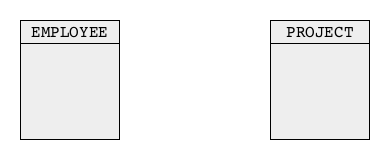
- Step 1: Creating classes of objects
- A group of employees works on the projects. Some of employees supervise other employees. An employee is described by an employee number and full name. A project is described by a project title, completion date and budget. Employees are identified by their employee numbers and projects are identified by the titles
Example 1
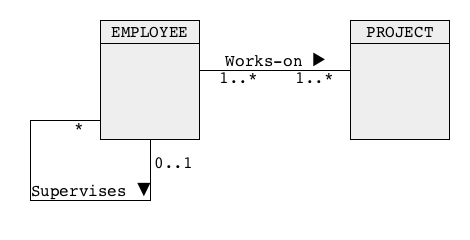
- Step 2: Creating associations and association classes
- A group of employees works on the projects. Some of employees supervise other employees. An employee is described by an employee number and full name. A project is described by a project title, completion date and budget. Employees are identified by their employee numbers and projects are identified by the titles
Example 1
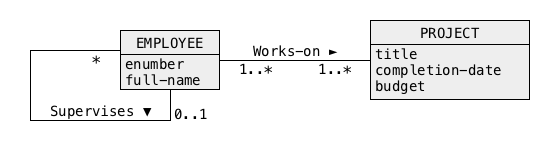
- Step 3: Creating attributes and link attributes
- A group of employees works on the projects. Some of employees supervise other employees. An employee is described by an employee number and full name. A project is described by a project title, completion date and budget. Employees are identified by their employee numbers and projects are identified by the titles
Example 1
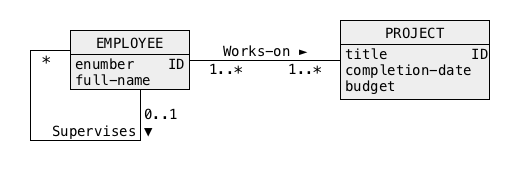
- Step 4: Creating identifiers
- A group of employees works on the projects. Some of employees supervise other employees. An employee is described by an employee number and full name. A project is described by a project title, completion date and budget. Employees are identified by their employee numbers and projects are identified by the titles
Example 1
- Step 5: Creating qualifications
- A group of employees works on the projects. Some of employees supervise other employees. An employee is described by an employee number and full name. A project is described by a project title, completion date and budget. Employees are identified by their employee numbers and projects are identified by the titles
Example 1
- Step 6: Creating generalizations
- A group of employees works on the projects. Some of employees supervise other employees. An employee is described by an employee number and full name. A project is described by a project title, completion date and budget. Employees are identified by their employee numbers and projects are identified by the titles
Conceptual Modeling
Outline
Example 2
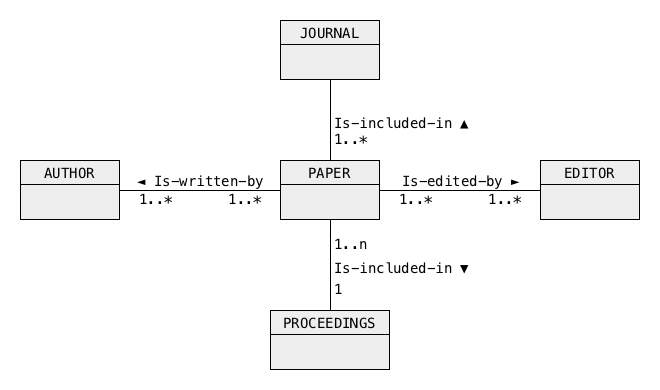
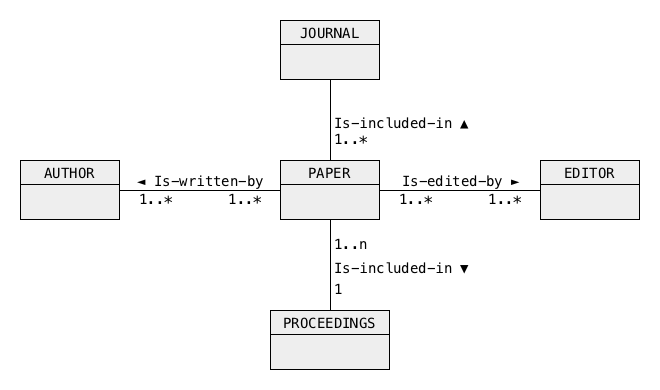
- An objective is to create a conceptual schema of a small database that contains information about publications such as journals and conference proceedings, published research papers and authors
- A detailed specification is the following:
- A publishing company publishes the journals and conference proceedings
- The research papers are included in the journals and proceedings
- The company employs the general editors who take responsibility for editing the research papers
- A research paper is written by one or more authors
Example 2
- Step 1: Creating classes of objects
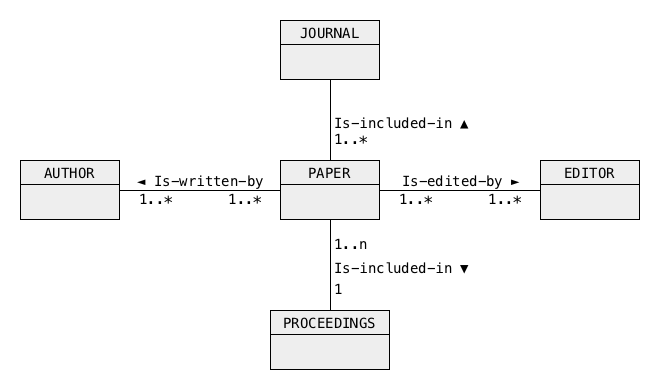
- A publishing company publishes the journals and conference proceedings. The research papers are included in the journals and proceedings. The company employs the general editors who take responsibility for editing the research papers. A research paper is written by one or more authors

Example 2
- Step 2: Creating associations and association classes
- A publishing company publishes the journals and conference proceedings. The research papers are included in the journals and proceedings. The company employs the general editors who take responsibility for editing the research papers. A research paper is written by one or more authors
Example 2
- Step 3: Creating attributes and link attributes
- A publishing company publishes the journals and conference proceedings. The research papers are included in the journals and proceedings. The company employs the general editors who take responsibility for editing the research papers. A research paper is written by one or more authors
Example 2
- Step 4: Creating identifiers
- A publishing company publishes the journals and conference proceedings. The research papers are included in the journals and proceedings. The company employs the general editors who take responsibility for editing the research papers. A research paper is written by one or more authors
Example 2
- Step 5: Creating qualifications
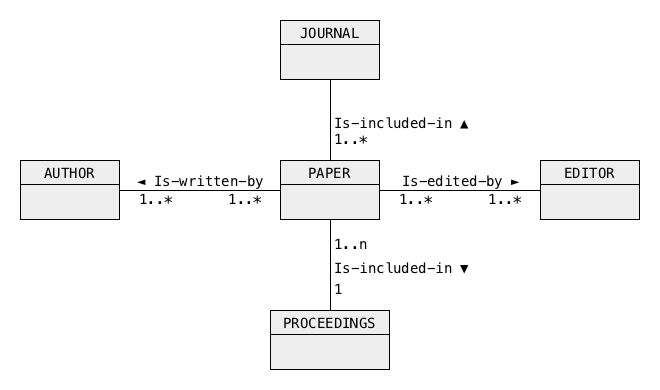
- A publishing company publishes the journals and conference proceedings. The research papers are included in the journals and proceedings. The company employs the general editors who take responsibility for editing the research papers. A research paper is written by one or more authors
Example 2
- Step 6: Creating generalizations
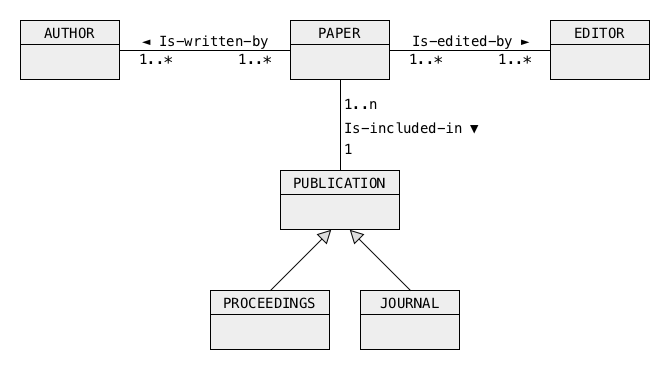
- A publishing company publishes the journals and conference proceedings. The research papers are included in the journals and proceedings. The company employs the general editors who take responsibility for editing the research papers. A research paper is written by one or more authors
- Journal, proceedings IS-A publication
Conceptual Modeling
Outline
Example 3
- An objective is to create a conceptual schema of a small database that contains information about the construction companies and buildings built by the companies
- A detailed specification is the following:
- A group of construction companies is involved in the construction of industrial buildings
- A building is located at a different address, it has a unique name and completion date
- A number of construction stages apply to each building
- A construction stage is described by its name, the names of the construction companies involved together with the start date, completion date and the total costs
- A construction company is usually involved in many construction stages of the same building
- Many construction companies are involved in one construction stage
Example 3
- Step 1: Creating classes of objects
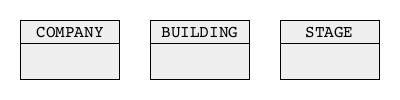
- A group of construction companies is involved in the construction of industrial buildings. A building is located at a different address, it has a unique name and completion date. A number of construction stages apply to each building. A construction stage is described by its name, the names of the construction companies involved together with the start date, completion date and the total costs. A construction company is usually involved in many construction stages of the same building. Many construction companies are involved in one construction stage
Example 3
- Step 2: Creating associations and association classes
- A group of construction companies is involved in the construction of industrial buildings. A building is located at a different address, it has a unique name and completion date. A number of construction stages apply to each building. A construction stage is described by its name, the names of the construction companies involved together with the start date, completion date and the total costs. A construction company is usually involved in many construction stages of the same building. Many construction companies are involved in one construction stage
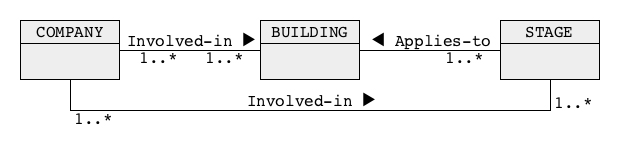
Example 3
- Step 2 (improved): Creating associations and association classes
- A group of construction companies is involved in the construction of industrial buildings. A building is located at a different address, it has a unique name and completion date. A number of construction stages apply to each building. A construction stage is described by its name, the names of the construction companies involved together with the start date, completion date and the total costs. A construction company is usually involved in many construction stages of the same building. Many construction companies are involved in one construction stage
- If a company is involved in a construction stage that applies to a building then such company is involved in construction of the building
Example 3
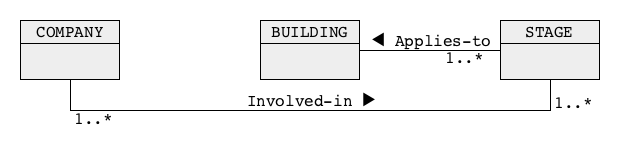
- Step 2 (improved): Creating associations and association classes
- It means that we do not need an association Involved-in bettwen the classes COMPANY and BUILDING because such association can be derived from the other two associations
Example 3
- Step 3: Creating attributes and link attributes
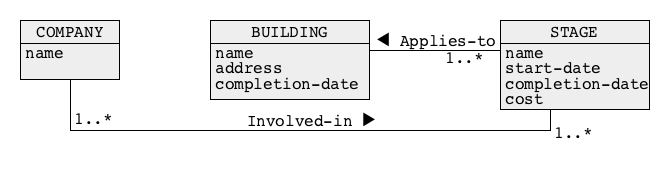
- A group of construction companies is involved in the construction of industrial buildings. A building is located at a different address, it has a unique name and completion date. A number of construction stages apply to each building. A construction stage is described by its name, the names of the construction companies involved together with the start date, completion date and the total costs. A construction company is usually involved in many construction stages of the same building. Many construction companies are involved in one construction stage
Example 3
- Step 4: Creating identifiers
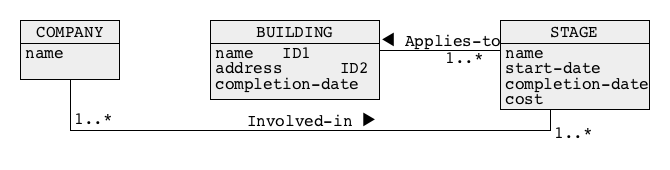
- A group of construction companies is involved in the construction of industrial buildings. A building is located at a different address, it has a unique name and completion date. A number of construction stages apply to each building. A construction stage is described by its name, the names of the construction companies involved together with the start date, completion date and the total costs. A construction company is usually involved in many construction stages of the same building. Many construction companies are involved in one construction stage
- What we know about the reality is that construction companies have unique names
Example 3
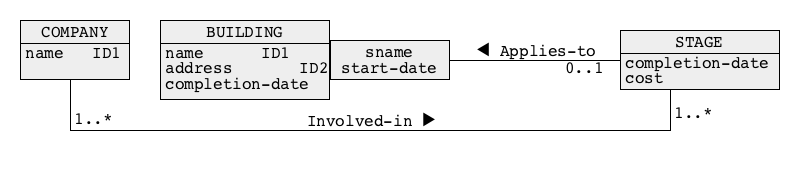
- Step 5: Creating qualifications
- A group of construction companies is involved in the construction of industrial buildings. A building is located at a different address, it has a unique name and completion date. A number of construction stages apply to each building. A construction stage is described by its name, the names of the construction companies involved together with the start date, completion date and the total costs. A construction company is usually involved in many construction stages of the same building. Many construction companies are involved in one construction stage
- What we also know about the reality is that a construction stage of a building starts once at a given moment in time
Example 3
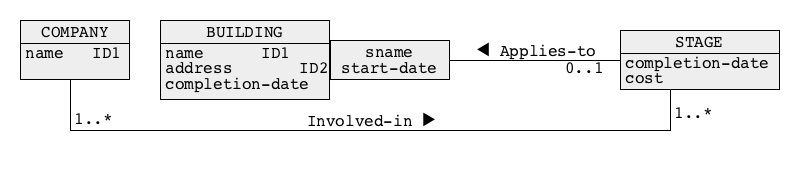
- Step 6: Creating generalizations
- A group of construction companies is involved in the construction of industrial buildings. A building is located at a different address, it has a unique name and completion date. A number of construction stages apply to each building. A construction stage is described by its name, the names of the construction companies involved together with the start date, completion date and the total costs. A construction company is usually involved in many construction stages of the same building. Many construction companies are involved in one construction stage
Conceptual Modeling
Outline
Example 4
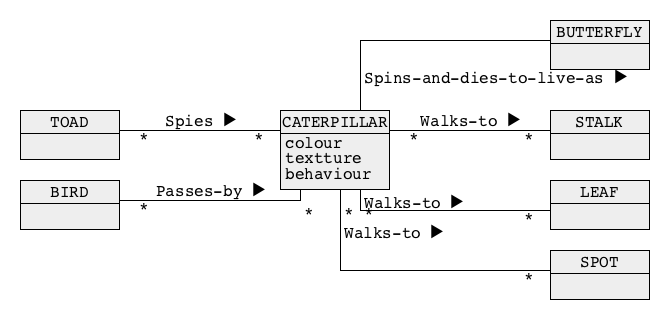
- An objective is to create a conceptual schema for a database domain described by the following poem for kids
- "Caterpillar"
- by Christina Rossetti
- Brown and furry
- Caterpillar in a hurry,
- Take your walk
- To the shady leaf, or stalk,
- Or what not,
- Which may be the chosen spot.
- No toad spy you,
- Hovering bird of prey pass by you;
- Spin and die,
- To live again a butterfly.
Example 4
- Step 1: Creating classes of objects
- Brown and furry Caterpillar in a hurry Take your walk To the shady leaf, or stalk, Or what not, Which may be the chosen spot. No toad spy you, Hovering bird of prey pass by you; Spin and die, To live again a butterfly.

Example 4
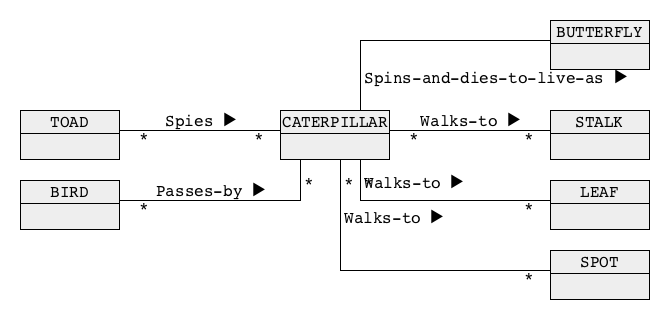
- Step 2: Creating associations and association classes
- Brown and furry Caterpillar in a hurry Take your walk To the shady leaf, or stalk, Or what not, Which may be the chosen spot. No toad spy you, Hovering bird of prey pass by you; Spin and die, To live again a butterfly.
Example 4
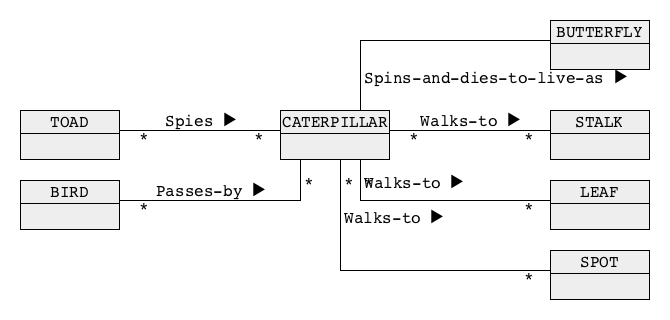
- Step 3: Creating attributes and link attributes
- Brown and furry Caterpillar in a hurry Take your walk To the shady leaf, or stalk, Or what not, Which may be the chosen spot. No toad spy you, Hovering bird of prey pass by you; Spin and die, To live again a butterfly.
Example 4
- Step 4: Creating identifiers
- Brown and furry Caterpillar in a hurry Take your walk To the shady leaf, or stalk, Or what not, Which may be the chosen spot. No toad spy you, Hovering bird of prey pass by you; Spin and die, To live again a butterfly.
Example 4
- Step 5: Creating qualifications
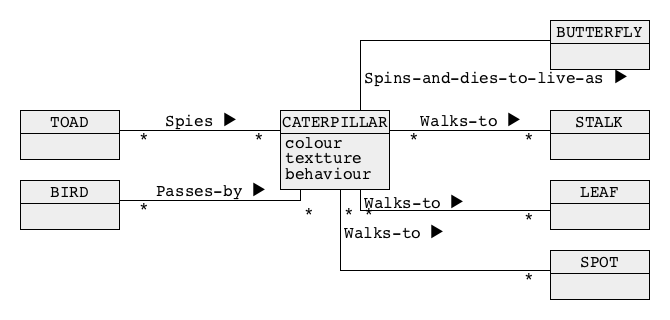
- Brown and furry Caterpillar in a hurry Take your walk To the shady leaf, or stalk, Or what not, Which may be the chosen spot. No toad spy you, Hovering bird of prey pass by you; Spin and die, To live again a butterfly.
Example 4
- Step 6: Creating generalizations
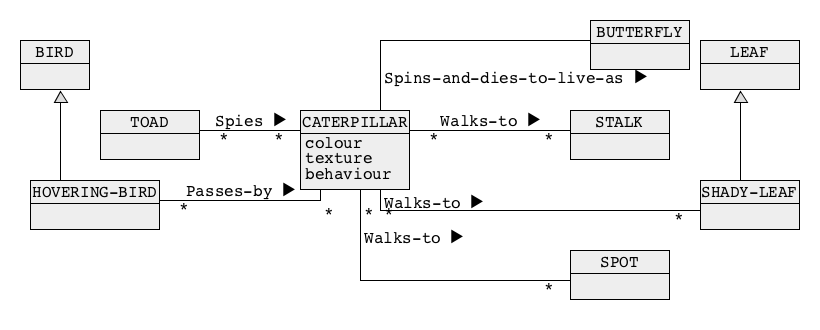
- Brown and furry Caterpillar in a hurry Take your walk To the shady leaf, or stalk, Or what not, Which may be the chosen spot. No toad spy you, Hovering bird of prey pass by you; Spin and die, To live again a butterfly.
References
- C. Coronel, S. Morris, A. Basta, M. Zgola, Data Management and Security, Chapters 3 and 4, Cengage Compose eBook, 2018, eBook: Data Management and Security, 1st Edition
- T. Connoly, C. Begg, Database Systems, A Practical Approach to Design, Implementation, and Management, Chapter 16 Methodology - Conceptual Database Design, Pearson Education Ltd, 2015
- How to ... ? Cookbook, How to use UMLetlet for conceptual modeling ? Recipe 2.1 How to create very simple conceptual schemas with UMLetlet ?
- How to ... ? Cookbook, How to use UMLetlet for conceptual modeling ? Recipes 2.2, 2.3, and 2.4 How to do design a conceptual schema with UMLetlet (Design 1, 2, and 3) ?