Pig Latin
Outline
Preliminary Matters
- Pig Latin is a dataflow language
- Each processing step results in a new data set, or relation
A = load 'NYSE_dividends' (exchange, symbol, date, dividends);
B = filter A by dividends > 0;
C = foreach B generate UPPER(symbol);
- A = load 'foo'; is not equivalent to a = load 'foo';
A = load 'foo'; -- this is a single-line comment
/*
  This is a multiline comment.
*/
Pig Latin
Outline
Input in Pig Latin
- load
- By default, load looks for your data on HDFS in a tab-delimited file using the default load function PigStorage
divs = load '/data/examples/file';
hdfs://[host-name]:[port- name]/data/examples
divs = load '/data/examples/file' using HBaseStorage(,);
divs = load '/data/examples/file' as (exchange: int, symbol: chararray);
Output in Pig Latin
- store
- Pig stores your data on HDFS in a tab-delimited file using PigStorage
store processed into '/data/examples/processed';
dump processed;
Pig Latin
Outline
Arithmetic, Boolean and relational Operations
- Pig Latin supports the following basic operations
- arithmetic operations: +, -, *, /
- Boolean operations: and, or, not
- relational operations: ==, !=, <,>, <=, >=, matches (pattern matching)
- Relational operations are the main tools Pig Latin provides to operate on your data
- They are the horsepower of Pig Latin
- They allow you to transform the operations such as sorting, grouping, joining, projecting, and filtering
Pig Latin
Outline
Built-In Functions
- Mathematical functions
- AVG, COUNT, MAX, MIN, SIZE, SUM, ABS, CEIL, EXP, FLOOR,LOG, RANDOM, ROUND, and others
- String functions
- STARTWITH, ENDWITH, LOWER, UPPER, REGEX_EXTRACT, TOKENIZE, and others
- Date/time functions
- CurrentTime, DaysBetween, GetDay, GetHour, GetMinute, ToDate, and others
Pig Latin
Outline
Foreach
- foreach takes a set of expressions and applies them to every record in
the data pipeline, it is the projecting and transforming operation
A = load 'input' as (user:chararray, id:long, address:chararray, phone:chararray,
		     preferences:map[]);
B = foreach A generate user, id;
prices = load 'NYSE_daily' as (exchange, symbol, date, open, high, low, close,
                               volume, adj_close);
gain = foreach prices generate close - open;
gain2 = foreach prices generate $6 - $3;
Foreach
- Some other expressions
prices = load 'NYSE_daily' as (exchange, symbol, date, open, high, low,
                               close, volume, adj_close);
beginning = foreach prices generate ..open;
-- produces exchange, symbol, date, open

middle = foreach prices generate open..close;
-- produces open, high, low, close

end = foreach prices generate volume..;
-- produces volume, adj_close

all_in_one = foreach prices generate *;
-- produces a tuple of all fields
bball = load 'baseball' as (name:chararray, team:chararray,
                            position:bag{t:(p:chararray)}, bat:map[]);
bball_avg = foreach bball generate bat#'batting_average';
bball_p = foreach bball generate position.p;
Pig Latin
Outline
Filter
- filter statement allows you to select which records will be retained in your data pipeline
- A filter contains a predicate
- If a predicate evaluates to true for a given record, that record will be passed down the pipeline
- Otherwise, it will not
divs = load 'NYSE_dividends' as (exchange:chararray, symbol:chararray,
                                 date:chararray, dividends:float);
startswithcm = filter divs by symbol matches 'CM.*';
-- Only records matching the pattern 'CM.*' are retained
Pig Latin
Outline
Group
- group statement collects together records with the same key
- It is sharing its syntax with SQL, but the grouping operator in Pig Latin is fundamentally different than the one in SQL
- In SQL GROUP BY clause creates a group that must feed directly into one or more aggregate functions
- In Pig Latin there is no direct connection between group and aggregate functions
- Instead, group does exactly what it says, i.e. it collects all records with the same value for the provided key together into a bag
daily = load 'NYSE_daily' as (exchange:chararray, stock_id:int);
grpd = group daily by stock_id;
describe grpd;
grpd: {group: (stock_id: int), daily: {exchange: chararray,stock_id: int}}
Group
- Group supports multiple keys
- The resulting records still have two fields and group field is a tuple with a field for each key
daily = load 'NYSE_daily' as (exchange, stock, date, dividends);
grpd = group daily by (exchange, stock);
avg = foreach grpd generate group, AVG(daily.dividends);
describe grpd;
grpd: {group: (exchange: bytearray,stock: bytearray),daily: {exchange: bytearray,
                                                             stock: bytearray,
                                                             date: bytearray,
                                                             dividends: bytearray}}
daily = load 'NYSE_daily' as (exchange, stock);
grpd = group daily all;
--grpd will have only one row containing all records
Pig Latin
Outline
Order By
- order by statement sorts producing a total order of output data
- The syntax of order by is similar to group statement
- Data is sorted based on the types of the indicated fields: numeric values are sorted numerically, chararray fields are sorted lexically
daily = load 'NYSE_daily' as (exchange:chararray, symbol:chararray, date:chararray,
		                                                      open:float);
byclose = order daily by close desc, open;

dump byclose;
-- first close in descending order, then open sorted in ascending order
Pig Latin
Outline
Distinct
- distinct statement removes duplicate records
daily = load 'NYSE_daily' as (exchange:chararray, symbol:chararray);
uniq = distinct daily;
Pig Latin
Outline
Joins
- join operations in Pig are analogous to the join operations in SQL
- join operations combine records from two bags based on a common field
- join operations act on two different data sets where one field in each data set is nominated as a join key
- In a join, the first (second) dataset specified is called as the left (right) entity or data set
Joins
- Types of join operation
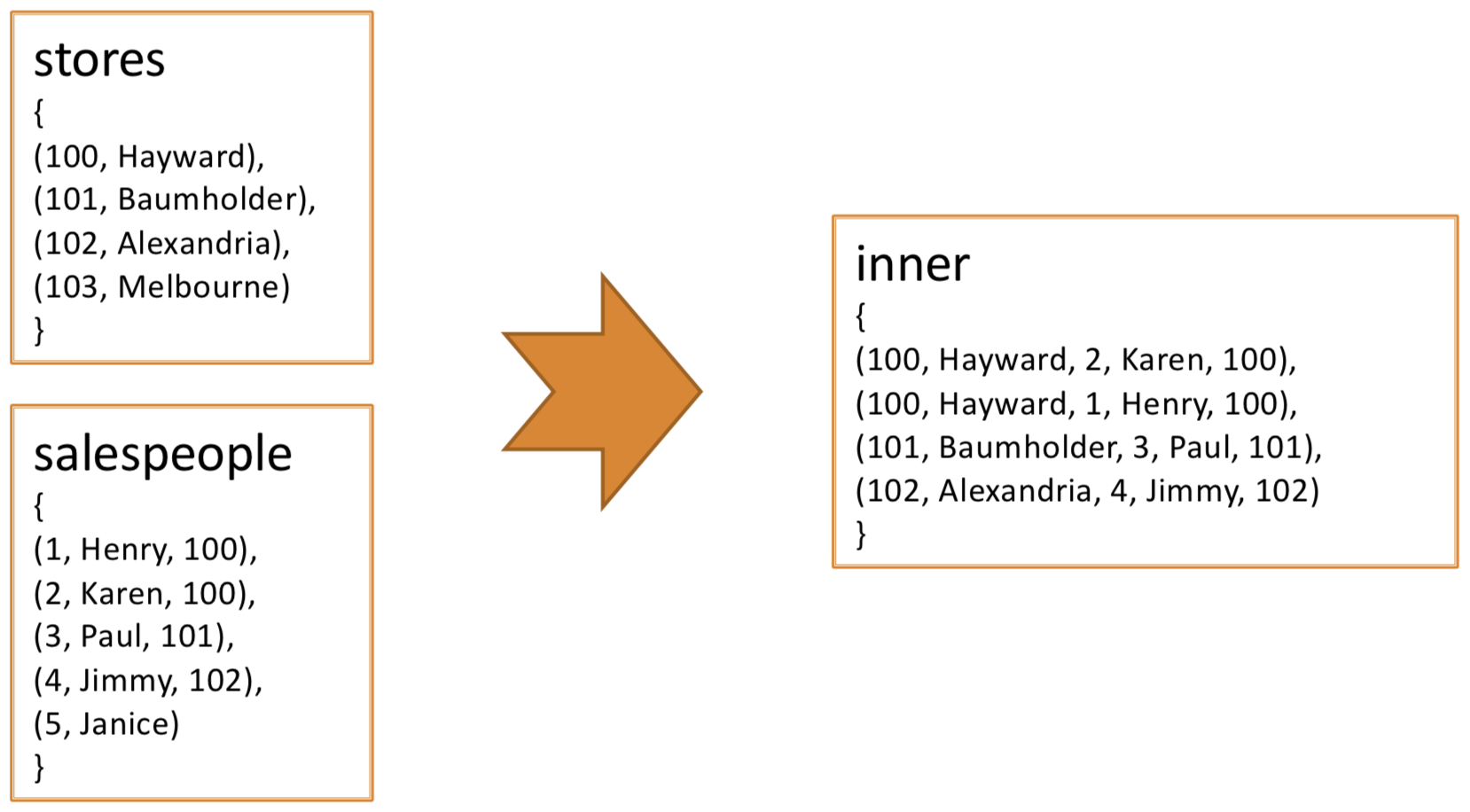
- inner join, often simply called a join, returns all elements or records from both datasets where the nominated key is present in both datasets
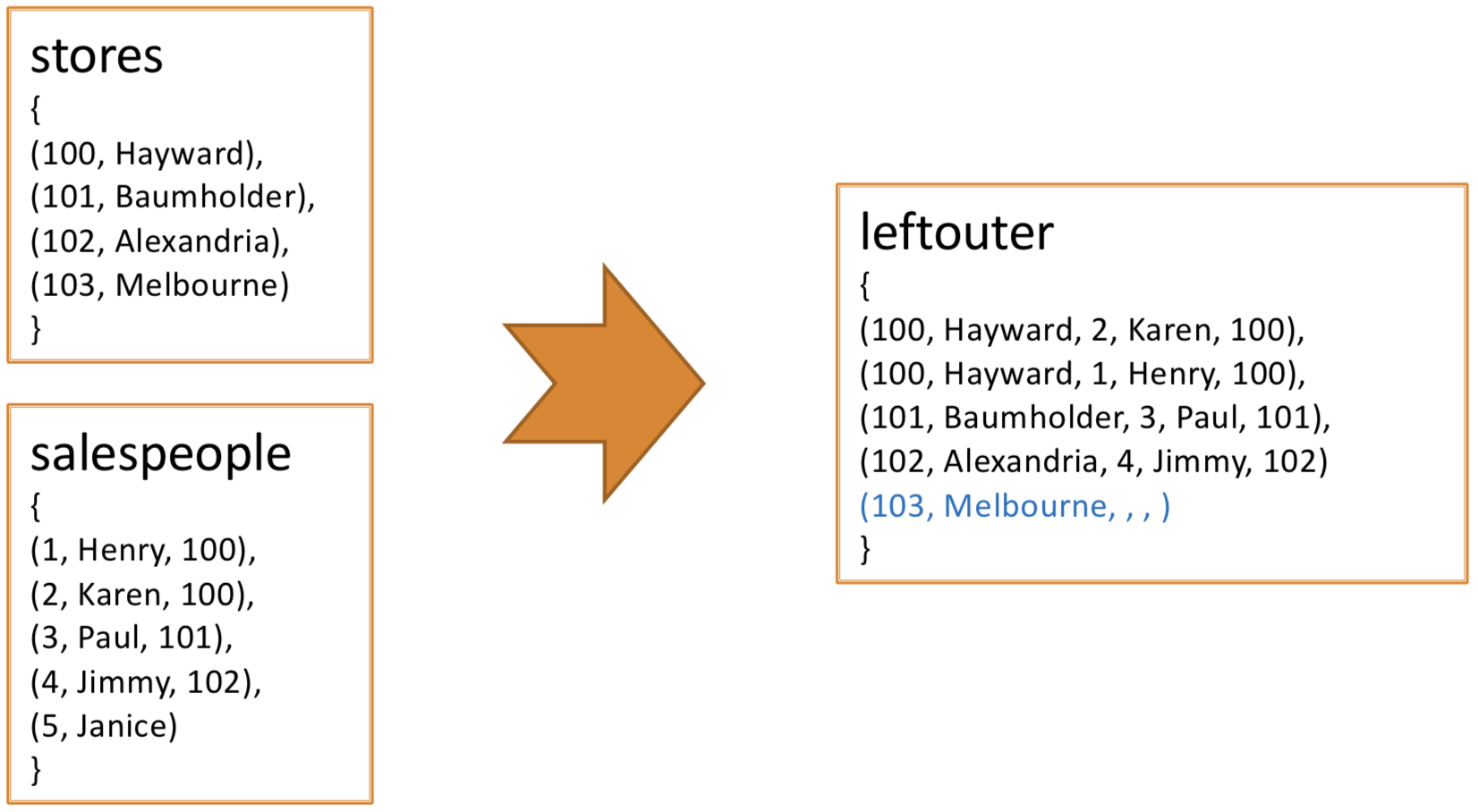
- left outer join returns all records from the left, or first dataset along with matched records only (by the specified key) from the right, or second, dataset
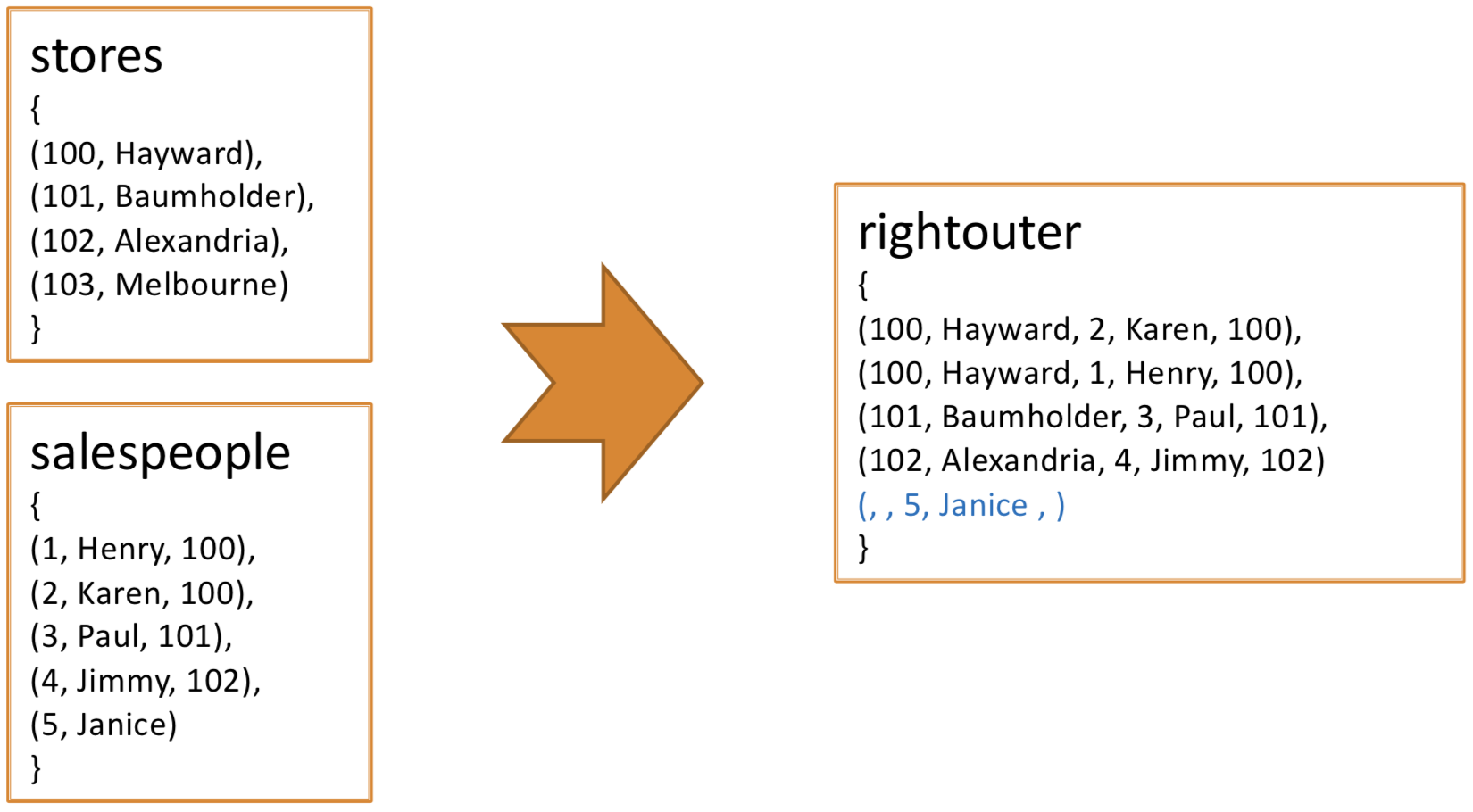
- right outer join returns all records from the right, or second dataset along with matched records only (by the specified key) from the left, or first dataset
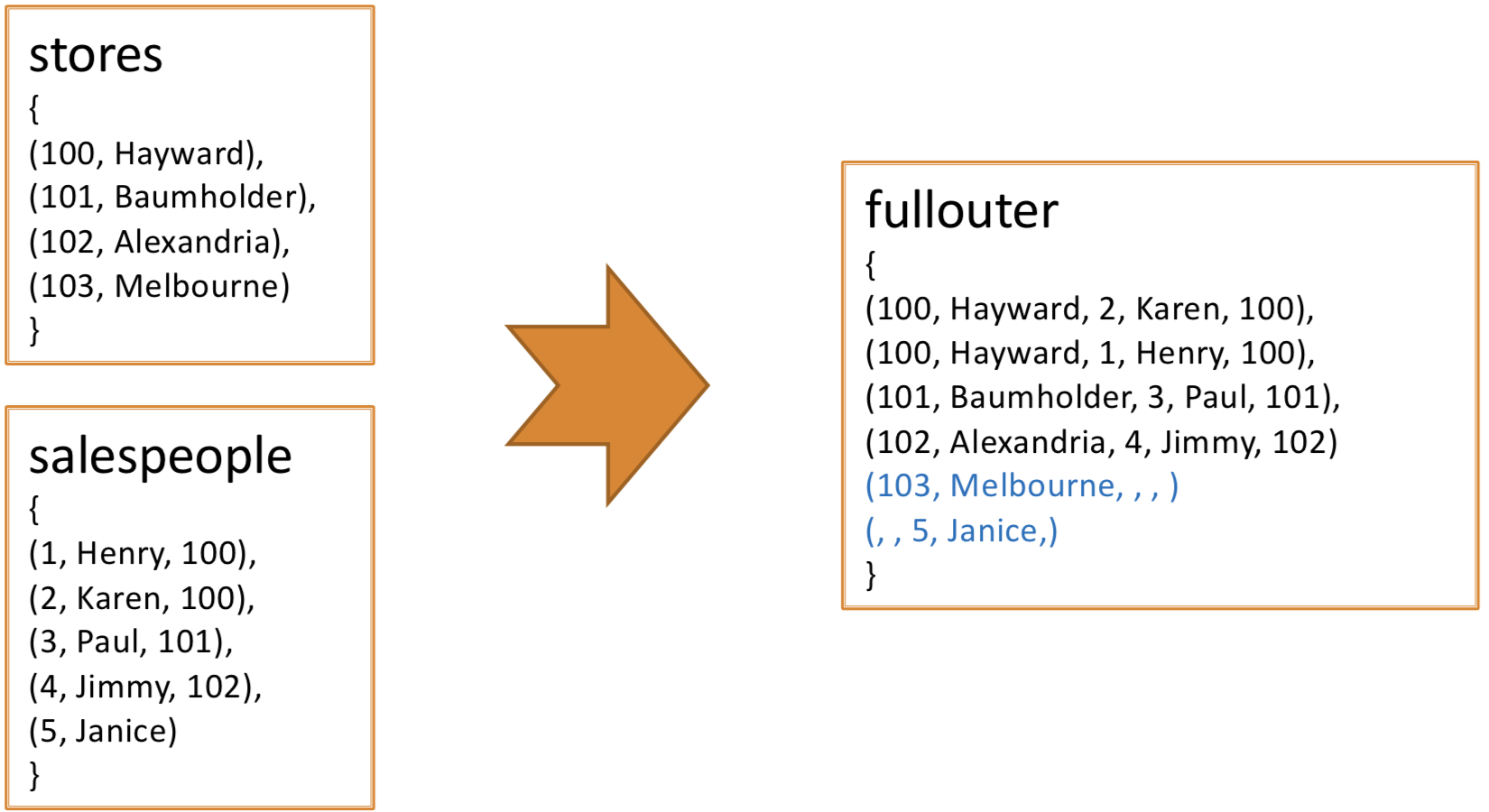
- full outer join returns all records from both datasets whether there is a key match or not
Inner Join
-
inner = JOIN stores BY storied, salespeople BY storeid;
Left Outer Join
-
leftouter = JOIN stores BY storied LEFT OUTER, salespeople BY storeid;
Right Outer Join
-
rightouter = JOIN stores BY storied RIGHT OUTER, salespeople BY storeid;
Full Outer Join
-
fullouter = JOIN stores BY storied FULL OUTER, salespeople BY storeid;
Pig Latin
Outline
Limit and Sample
- Sometimes we want to see only a limited number of results
- limit statement allows for the restriction of an output to a given number of the first records
- The following returns at most 10 lines, i.e., the first 10 records
divs = load 'NYSE_dividends';
first10 = limit divs 10;
divs = load 'NYSE_dividends';
some = sample divs 0.1;
References
- Gates A., Programming Pig, O'Reilly Media, Inc., 2011, (Available in READINGS folder)
- Vaddeman B., Beginning Apache Pig: Big Data Processing Made Easy, Apress 2016 (Available in READINGS folder)