Hadoop Architecture
Outline
HDFS: Hadoop Distributed File System
- HDFS is designed for:
- Very large files
- Stream data access
- Commodity hardware
- But not for:
- Low-latency data access
- Lots of small files
- Multiple writers, arbitrary file modifications
HDFS: Hadoop Distributed File System
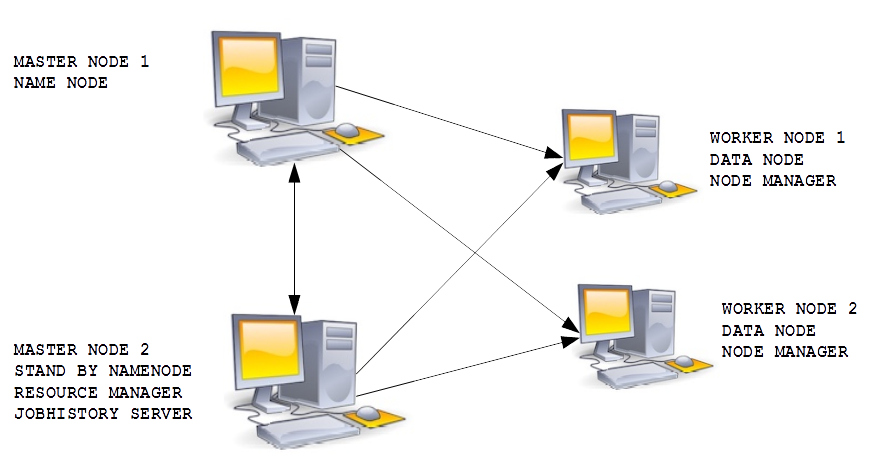
- HDFS contains the following key components:
- NameNode:
- HDFS master node process
- manages the filesystem metadata
- does not store a file itself
- SecondaryNameNode and Standby NameNode
- SecondaryNameNode expedites the filesystem metadata recovery
- Standby NameNode (optional) provides high availability
- DataNode
- runs HDFS slave node process
- manages block storage and access for reading or writing of data, block replication
HDFS: Hadoop Distributed File System
- Architecture of HDFS
HDFS: Hadoop Distributed File System
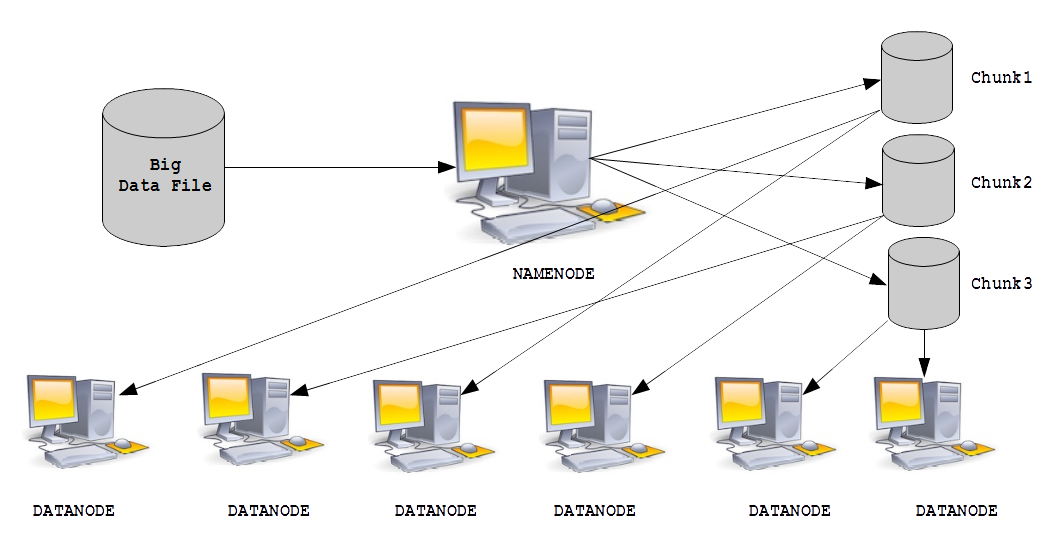
- HDFS is a virtual filesystem
- appears to a client as one file system, but the data is stored in multiple different locations
- deployed on the top of the native filesystems (such as ext3, ext4 and xfs in Linux)
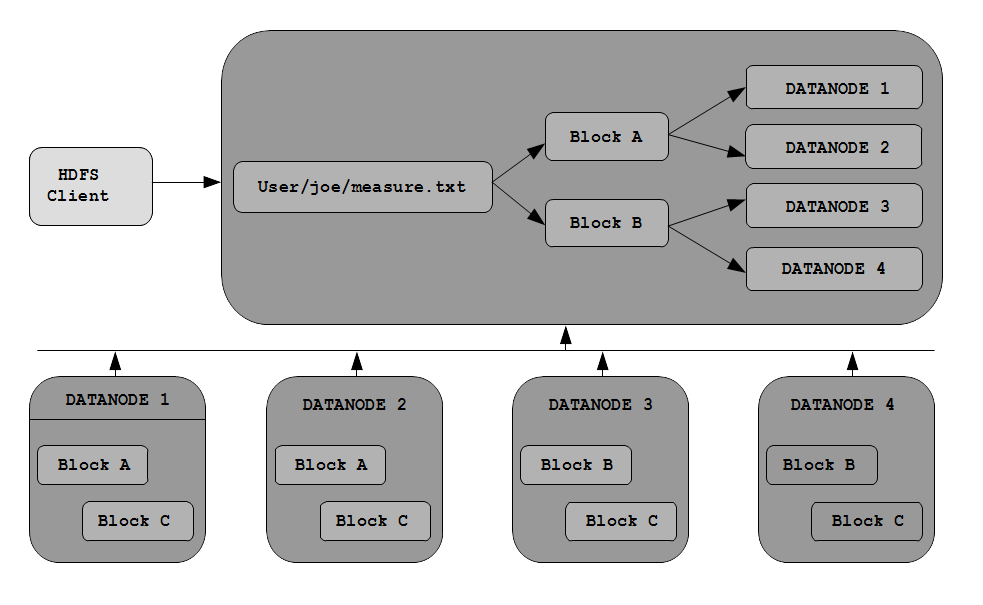
- Each file in HDFS consists of blocks
- The size of each block defaults to 128MB but is configurable
- The default number of replicates for blocks is 3, but it is also configurable
HDFS: Hadoop Distributed File System
- Logical view of data storage
HDFS: Hadoop Distributed File Systeme
- Physical implementation of data file storage
Hadoop Architecture
Outline
NameNode Metadata
- NameNode stores the metadata of the files in HDFS
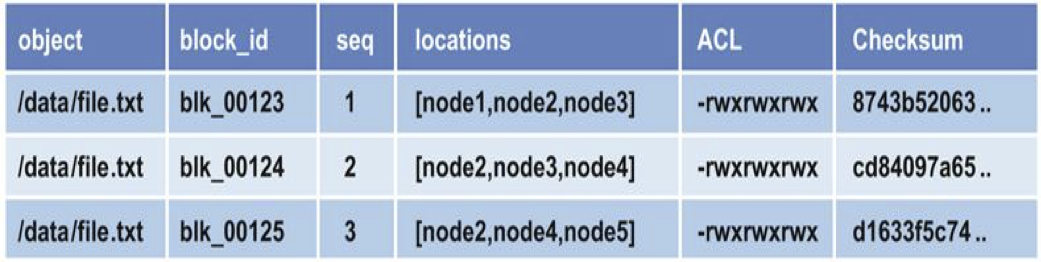
- NameNode functions:
- Maintain the metadata pertaining to the file system (e.g., the file hierarchy and the block locations for each file)
- Manage user access to the data files
- Map the data blocks to the DataNodes in the cluster
- Perform file system operations (e.g., opening and closing the files and directories)
- Provide registration services and periodic heartbeats for DataNodes
Hadoop Architecture
Outline
DataNode and Secondary node
- DataNode functions:
- Provide the block storage by storing blocks on the local file system
- Fulfil the read/write requests
- Replicating data across the cluster
- Keeping in touch with the NameNode by sending periodic block reports and heartbeats
- A heartbeat confirms the DataNode is alive and healthy, and a block report shows the blocks being managed by the DataNode
- Secondary NameNode and Standby NameNode functions:
- Without a NameNode, there is no way to know to which files the blocks stored on the DataNodes correspond to
- In essence, all files in HDFS are lost
- Secondary NameNode periodically backups the metadata in the (primary) NameNode, which is usually for recovery
- Standby NameNode is a hot node that running together with the (primary) NameNode in the cluster, facilitating high-availability
Hadoop Architecture
Outline
Yet Another Resource Negotiator (YARN)
- YARN: the core subsystem in Hadoop responsible for governing, allocating, and managing the finite distributed processing resources available on a Hadoop cluster
- introduced in Hadoop 2 to improve the MapReduce implementation, but general enough to support other distributed computing paradigms
- YARN provides its core services via two types of long-running daemons:
- A ResourceManager (one per cluster) to manage the use of resources across the cluster, and
- NodeManagers running on all the nodes in the cluster to launch and monitor containers
Yet Another Resource Negotiator (YARN)
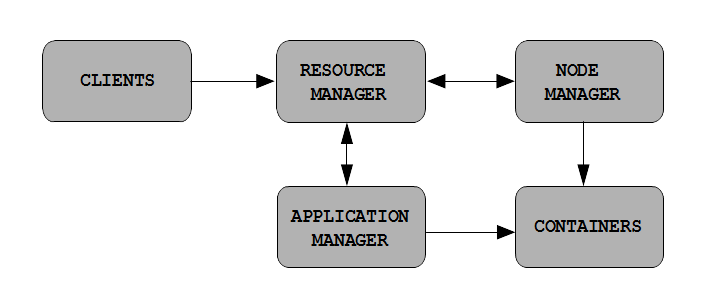
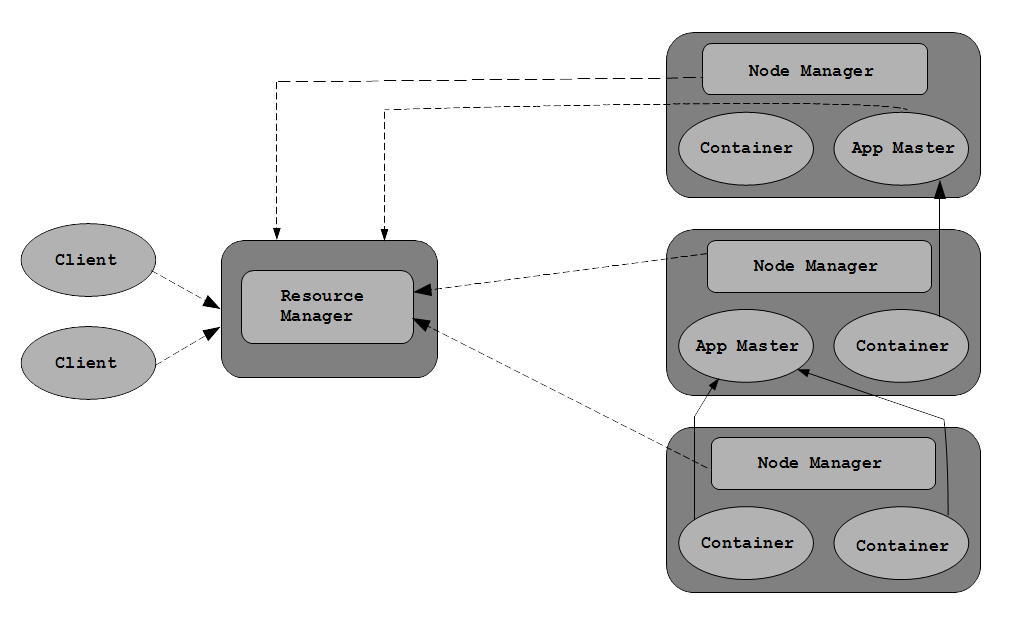
- Architecture of YARN
- A client is the program that submits jobs to the cluster
- May also be the gateway machine that the client program runs on
- A job, also called an application, contains one or more tasks
- A task in a MapReduce job can be either a mapper and a reducer task
- Each mapper and reducer task runs within a container
- Containers are logical constructs that represent a specific amount of memory and other resources, such as processing cores (CPU)
- For example, a container can represent 2GB memory and 2 processing cores
- Containers may also refer to the running environment of an application
Yet Another Resource Negotiator (YARN)
- Architecture of YARN
- ResourceManager: YARN's daemon running on a master node
- ResourceManager is responsible for granting cluster computing resources to applications running on the cluster
- Resources are granted the items of containers
- NodeManager: YARN's daemon running on a slave node.
- NodeManager manages containers on a slave node
- ApplicationMaster: the first container allocated by the ResourceManager to run on a NodeManager for each application
Yet Another Resource Negotiator (YARN)
- Architecture of YARN
Yet Another Resource Negotiator (YARN)
- Architecture of YARN
Hadoop Architecture
Outline
ResourceManager
- There is one ResourceManager per cluster, which consists of two key components: Scheduler and ApplicationManager
- Key functions of ResourceManager:
- Creates the first container for an application to run ApplicationMaster for that application
- Tracks the heartbeats from NodeManagers to manage DataNodes
- Runs Scheduler to determine resource allocation among the clusters
- Manages cluster level security
- Manages the resource requests from ApplicationMasters
- Monitors the status of ApplicationMasters and restarts that container upon its failure
- Deallocates the containers when the application completes or after they expire
- The role of ResourceManager is pure management and scheduler
- It does not perform any actual data processing, for example the Map and Reduce functions in a MapReduce application
Hadoop Architecture
Outline
NodeManager
- Each DataNode runs a NodeManager daemon for performing YARN functions
- Main functions of a NodeManager daemon:
- Communicates with ResourceManager through health heartbeats and container status notifications.
- Registers and starts the application processes
- Launches both ApplicationMaster and the rest of an application's resource containers (that is, the map and reduce tasks that run in the containers) on request from ApplicationMaster
- Oversees the lifecycle of the application containers
- Monitors, manages and provides information regarding the resource consumption (CPU/memory) by the containers
- Tracks the health of DataNode
- Provides auxiliary services to YARN applications, such as services used by the MapReduce framework for its shuffle and sort operations
Hadoop Architecture
Outline
ApplicationMaster
- For each YARN application, there is a dedicated ApplicationMaster
- Functions of ApplicationMaster:
- Managing task scheduling and execution
- Allocating resources locally for the application's tasks
- ApplicationMaster is running within a container
- ApplicationMaster's existence is associated with the running application
- When an application is completed, its ApplicationMaster no longer exists
- Once created, ApplicationMaster is in charge of requesting resources with ResourceManager to run the application
- The resource request are very specific, for example:
- the file blocks needed to process the job,
- the amount of the resource, in terms of the number of containers to create for the application,
- the size of the containers, etc.
Hadoop Architecture
Outline
Summary
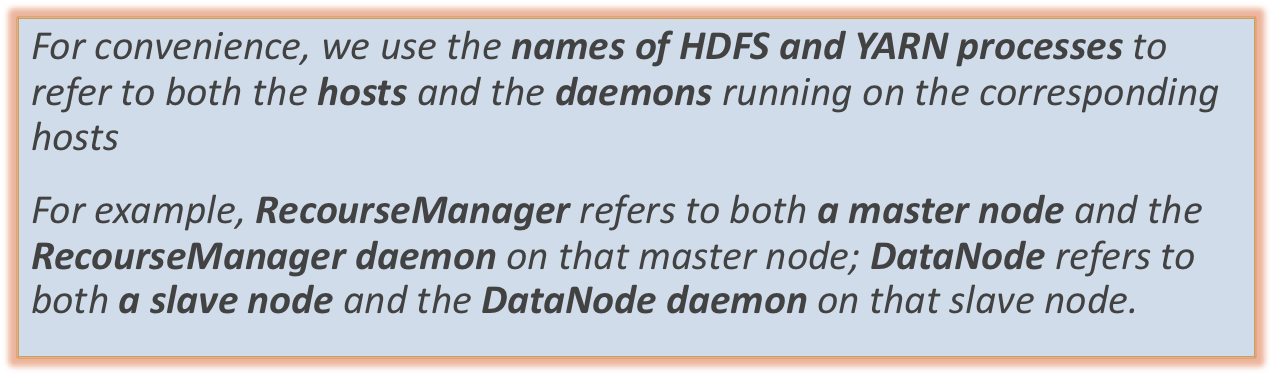
- Terminologies
- Hadoop is a leading platform for big data
- Hadoop consists of a storage layer (HDFS), a coordination and management layer (YARN) and a processing layer (e.g., MapReduce)
- HDFS and YARN have key services (daemons)
- MapReduce is a fundamental computing model (i.e., batch processing) for big data
- Next: Interaction with Hadoop and "dive" into the MapReduce framework
References
- White T., Hadoop The Definitive Guide: Storage and analysis at Internet scale, O'Reilly, 2015 (Available through UOW library)
- Vohra D., Practical Hadoop ecosystem: a definitive guide to Hadoop-related frameworks and tools, Apress, 2016 (Available through UOW library)
- Aven J., Hadoop in 24 Hours, SAMS Teach Yourself, SAMS 2017
- Alapati S. R., Expert Hadoop Adiministration: Managing, tuning, and securing Spark, YARN and HDFS, Addison-Wesley 2017
- Apache Hadoop, HDFS Interface
- Apache Hadoop, YARN