Stored PL/pgSQL
Outline
Stored PL/pgSQL ? What is it
- Stored PL/pgSQL means PL/pgSQL procedures and PL/pgSQL functions pre-compiled and stored in a data dictionary ready to be processed
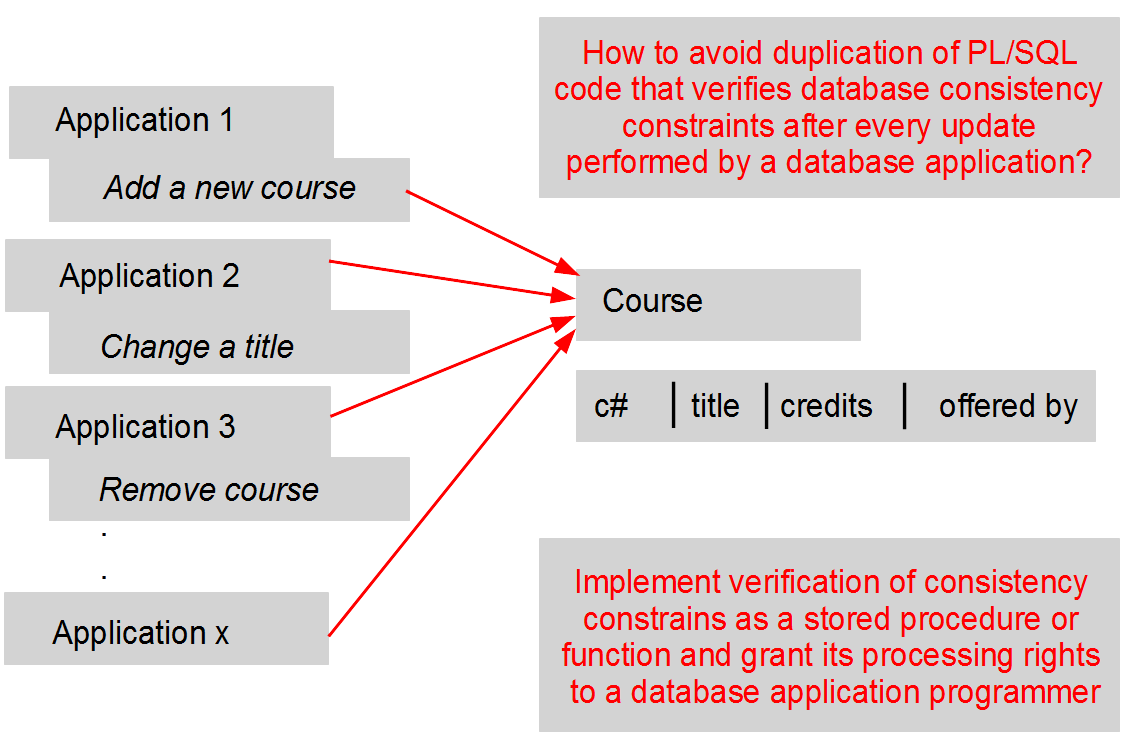
- Stored procedures and functions can be referenced or called any number of times by multiple applications processing the relational tables
- Stored procedures and functions can accept parameters when processed (called)
- Stored procedures can be called and processed with CALL statement
- Stored functions can be called and processed within SQL statement wherever a function can be used, for example as a row function in SELECT statement
- Stored procedures and stored functions can be used to extend the functionality of data retrieval and data manipulation statements of SQL (extensibility) and to eliminate duplication of code in the database applications (reuseability)
Stored PL/pgSQL ? What is it
- Stored procedures and functions can be created with SQL statements:
- CREATE OR REPLACE PROCEDURE
- CREATE OR REPLACE FUNCTION
Stored PL/pgSQL
Outline
Applications - reusability
Applications - extensibility
- Find the names of all departments together with a list of courses offered by each department, display the results in the following form:
DEPARTMENT NAME | LIST OF COURSES OFFERED
--------------------------------------------------------
Math            | Calculus Topology Logic Algebra
Comp Sci        | Python Java Databases
Biol            |
Phys            | Relativity Mechanics
Astro           | Astrology
SELECT dname, LCOURSES( dname )
FROM DEPARTMENT;
Stored PL/pgSQL
Outline
CREATE OR REPLACE PROCEDURE statement
- CREATE OR REPLACE PROCEDURE statement compiles and stores PL/pgSQL procedure in a data dictionary
- The following stored procedure INSERT_COURSE converts the values of string parameters to upper case and inserts a row into a relational table COURSE
CREATE OR REPLACE PROCEDURE INSERT_COURSE( cnumber  IN CHAR,
                                           ctitle   IN VARCHAR,
                                           ccredits IN NUMERIC,
                                           coffer   IN VARCHAR) AS $$
BEGIN
  INSERT INTO COURSE VALUES( cnumber, UPPER(ctitle), ccredits, coffer);
END;
$$ LANGUAGE plpgsql;
BEGIN;    -- Start a transaction
CALL insert_course('CSIT115','Data Management and Security',6,'Computer Science');
COMMIT;   -- Commit insertion and end a transaction
Stored PL/pgSQL
Outline
CREATE OR REPLACE FUNCTION statement
- CREATE OR REPLACE FUNCTION statement compiles and stores PL/pgSQL function in a data dictionary
- A stored function LCOURSES returns a string of characters with the titles of courses offered by a given department
CREATE OR REPLACE FUNCTION LCOURSES( dept_name VARCHAR )
RETURNS VARCHAR AS $$
DECLARE
  course_list VARCHAR(300);
  TITLES CURSOR FOR SELECT title FROM COURSE WHERE offered_by = dept_name;
BEGIN
  course_list := '';
  FOR course_rec IN TITLES
  LOOP
    course_list := course_list || course_rec.title || '|';
  END LOOP;
  RETURN course_list;
END;
$$ LANGUAGE plpgsql;
CREATE OR REPLACE FUNCTION statement
- A stored function LCOURSES is called as a row function in SELECT statement
SELECT name, LCOURSES(name)
FROM DEPARTMENT;
       name       |                                            lcourses
------------------+---------------------------------------------------------------
 Computer Science | Databases|Advanced Programming|Algorithms and Data Structures|
 Physics          | Mechanics|Relativity|
 Engineering      | Materials in Design|Engineering Computing and Analysis|C++|
 Mathematics      | Calculus|
 Business         | Accounting Fundamentals|Principles of Responsible Business|
 Education        | Introductory Principles of Education|
 Arts             |
 Science          | World Archaeology|
Stored PL/pgSQL
Outline
GRANT statement revisited
- In addition to read and write access rights it is possible to grant EXECUTE rights on stored procedures and functions
- For example, a user scott grants execution rights on a stored procedure INSERT_COURSE to a user janusz
GRANT EXECUTE ON PROCEDURE INSERT_COURSE(CHAR,VARCHAR,NUMERIC,VARCHAR) TO janusz;
CALL scott.INSERT_COURSE('CSIT958', 'Multimedia Databases', 6, 'Computer Science');
GRANT statement revisited
- For example, a user scott grants execution rights on a stored function LCOURSES to a user janusz
GRANT EXECUTE ON FUNCTION LCOURSES(VARCHAR) TO abc123;
SELECT name, scott.LCOURSES(name)
FROM DEPARTMENT;
References
- PostgreSQL 16.1 Documentation, Chapter 43. PL/pgSQL — SQL Procedural Language
- PostgreSQL Tutorial, PostgreSQL PL/pgSQL
- PostgreSQL 16.1 Documentation, CREATE PROCEDURE
- PostgreSQL 16.1 Documentation, CREATE FUNCTION
- PostgreSQL 16.1 Documentation, GRANT
- T. Connoly, C. Begg, Database Systems, A Practical Approach to Design, Implementation, and Management, Chapter 8 Advanced SQL, Pearson Education Ltd, 2015