SELECT statement (2)
Outline
Queries with simple conditions
- Sample database
CREATE TABLE DEPARTMENT(
 name               VARCHAR(50)        NOT NULL,
 code               CHAR(5)            NOT NULL,
 total_staff_number DECIMAL(2)         NOT NULL,
 chair              VARCHAR(50)            NULL,
 budget             DECIMAL(9,1)       NOT NULL,
  CONSTRAINT dept_pkey PRIMARY KEY(name),
  CONSTRAINT dept_ckey1 UNIQUE(code),
  CONSTRAINT dept_ckey2 UNIQUE(chair),
  CONSTRAINT dept_check1 CHECK (total_staff_number BETWEEN 1 AND 50) );
CREATE TABLE COURSE(
 cnum               CHAR(7)           NOT NULL,
 title              VARCHAR(200)      NOT NULL,
 credits            DECIMAL(2)        NOT NULL,
 offered_by         VARCHAR(50)           NULL,
  CONSTRAINT course_pkey PRIMARY KEY(cnum),
  CONSTRAINT course_check1 CHECK (credits IN (6, 12)),
  CONSTRAINT course_fkey1 FOREIGN KEY(offered_by)
                        REFERENCES DEPARTMENT(name) ON DELETE CASCADE );
Queries with simple conditions
- Find the titles of all 6 credit points courses
SELECT title
FROM COURSE
WHERE credits = 6;
SELECT title
FROM COURSE
WHERE credits IN (6, 12);
SELECT title, cnum
FROM COURSE
WHERE UPPER(title) LIKE '%DATABASE%';
SELECT statement (2)
Outline
Queries with Boolean expressions
- Find the titles of all 6 credit points courses offered by
a department of Physics
SELECT title
FROM COURSE
WHERE (credits = 6) AND (offered_by ='Physics');
SELECT title
FROM COURSE
WHERE (credits = 6) OR (offered_by ='Physics');
SELECT title
FROM COURSE
WHERE NOT (offered_by = 'Physics') AND (credits = 6);
Queries with Boolean expressions
- Find the titles of all 6 credit points courses that are not offered by a department of Physics
SELECT title
FROM COURSE
WHERE (offered_by != 'Physics') AND (credits = 6);
Queries with Boolean expressions
- Find the titles of all courses offered by a department of
Physics or offered by a department of Mathematics
SELECT title
FROM COURSE
WHERE (offered_by = 'Physics') OR (offered_by = 'Mathematics');
SELECT title
FROM COURSE
WHERE offered_by IN ('Physics', 'Mathematics');
SELECT title
FROM COURSE
WHERE(offered_by = 'Physics') AND (offered_by = 'Mathematics');
SELECT statement (2)
Outline
Set algebra queries
- Set operations: UNION, INTERSECTION, and DIFFERENCE

- A UNION B: all elements in A or in B
- A INTERSECTION B: all elements in A and in B
- A DIFFERENCE B: all elements in A and not in B
- B DIFFERENCE A: all elements in B and not in A
Set algebra queries
- UNION operation
- Find the credit points of courses offered by a department of Physics or a department of Mathematics and do not list duplicated rows
SELECT DISTINCT credits
FROM COURSE
WHERE (offered_by = 'Physics') OR (offered_by = 'Mathematics');
SELECT credits
FROM COURSE
WHERE offered_by = 'Physics'
UNION
SELECT credits
FROM COURSE
WHERE offered_by = 'Mathematics';
Set algebra queries
- UNION ALL operation
- Find the credit points of courses offered by a department of Physics or a department of Mathematics
SELECT credits
FROM COURSE
WHERE (offered_by = 'Physics') OR (offered_by = 'Mathematics');
SELECT credits
FROM COURSE
WHERE offered_by = 'Physics'
UNION ALL
SELECT credits
FROM COURSE
WHERE offered_by = 'Mathematics';
Set algebra queries
- What about other set operations like intersection (INTERSECT) and difference (MINUS) ?
- MySQL does not implement INTERSECT and MINUS set operations :( !!!
- So, how do we implement in MySQL queries with INTERSECT and MINUS set operations ?
- Find the credit points that can be earned both for a course offered by Physics and for a course offered by Mathematics
SELECT DISTINCT credits
FROM COURSE
WHERE offered_by = 'Physics' AND
      credits IN (SELECT credits
                  FROM COURSE
                  WHERE offered_by = 'Mathematics');
Set algebra queries
- What about other set operations like intersection (INTERSECT) and difference (MINUS) ?
- MySQL does not implement INTERSECT and MINUS set operations :( !!!
- So, how do we implement in MySQL queries with INTERSECT and MINUS set operations ?
- Find the credit points that can be earned for a course offered by Physics and cannot be earned for a course offered by Mathematics
SELECT DISTINCT credits
FROM COURSE
WHERE offered_by = 'Physics' AND
      credits NOT IN (SELECT credits
                      FROM COURSE
                      WHERE offered_by = 'Mathematics');
SELECT statement (2)
Outline
Sorting
- Sorting re-orders the rows in the results if a query
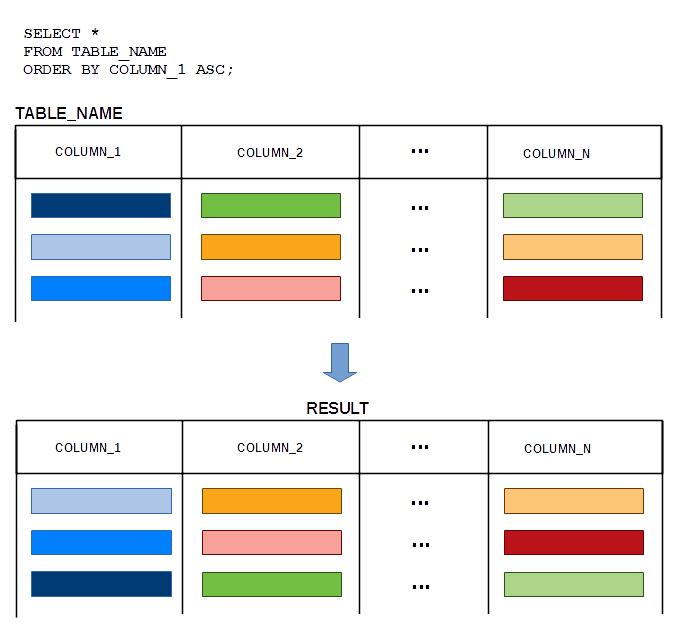
Sorting
- Find the numbers and titles of all 6 credit points courses sorted in the ascending order of titles
SELECT cnum, title
FROM COURSE
WHERE credits = 6
ORDER BY title ASC;
SELECT cnum, title
FROM COURSE
WHERE credits = 6
ORDER BY 2 ASC;
Sorting
- Find the numbers and titles of all 6 credit point courses sorted in
a descending order of titles
SELECT cnum, title
FROM COURSE
WHERE credits = 6
ORDER BY title DESC;
SELECT cnum, title
FROM COURSE
WHERE credits = 6
ORDER BY 2 DESC;
Sorting
- Find the numbers, titles, and credits of all courses sorted in an ascending order of credits and for all courses with the same credits sorted in descending order by titles
SELECT cnum, title, credits
FROM COURSE
ORDER BY credits ASC, title DESC;
SELECT cnum, title, credits
FROM COURSE
ORDER BY 3 ASC, 2 DESC;
SELECT statement (2)
Outline
Queries about lack of values (NULLs)
- Find the titles of all courses which are not offered now
SELECT title
FROM COURSE
WHERE offered_by IS NULL;
SELECT title
FROM COURSE
WHERE offered_by = NULL;
- WRONG !!! Lack of value cannot be compared with a value
Queries about lack of values (NULLs)
- Find the titles of all courses offered now
SELECT title
FROM COURSE
WHERE offered_by IS NOT NULL;
SELECT title
FROM COURSE
WHERE offered_by <> NULL;
- WRONG !!! Lack of value cannot be compared with a value
SELECT statement (2)
Outline
Grouping
- Grouping groups the rows before application of aggregation function
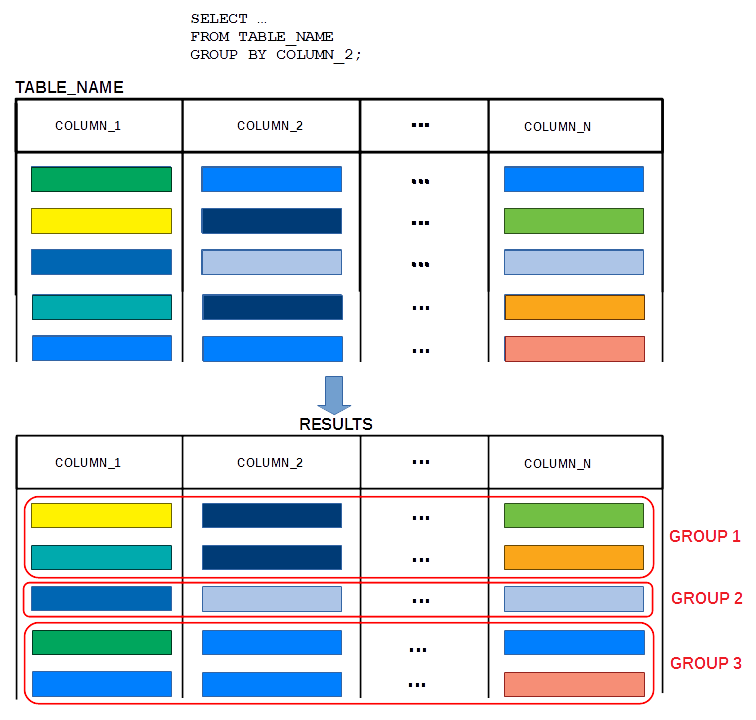
Grouping
- Next, aggregation function is applied to each group and the results are associated with the values taken from a column used for grouping
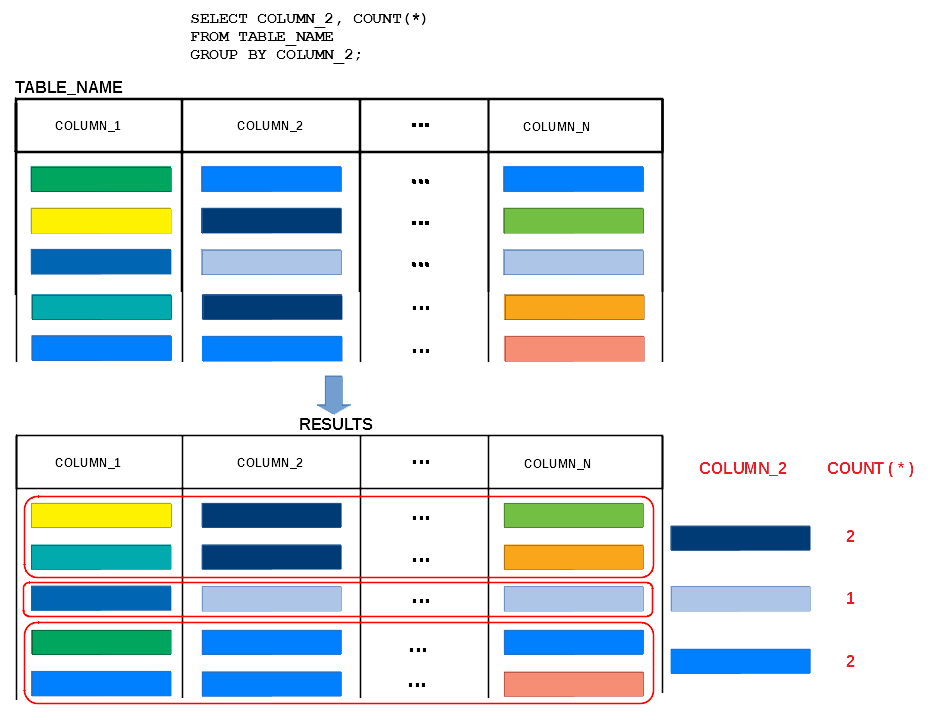
Grouping
- Aggregation function can be applied to an empty group of values
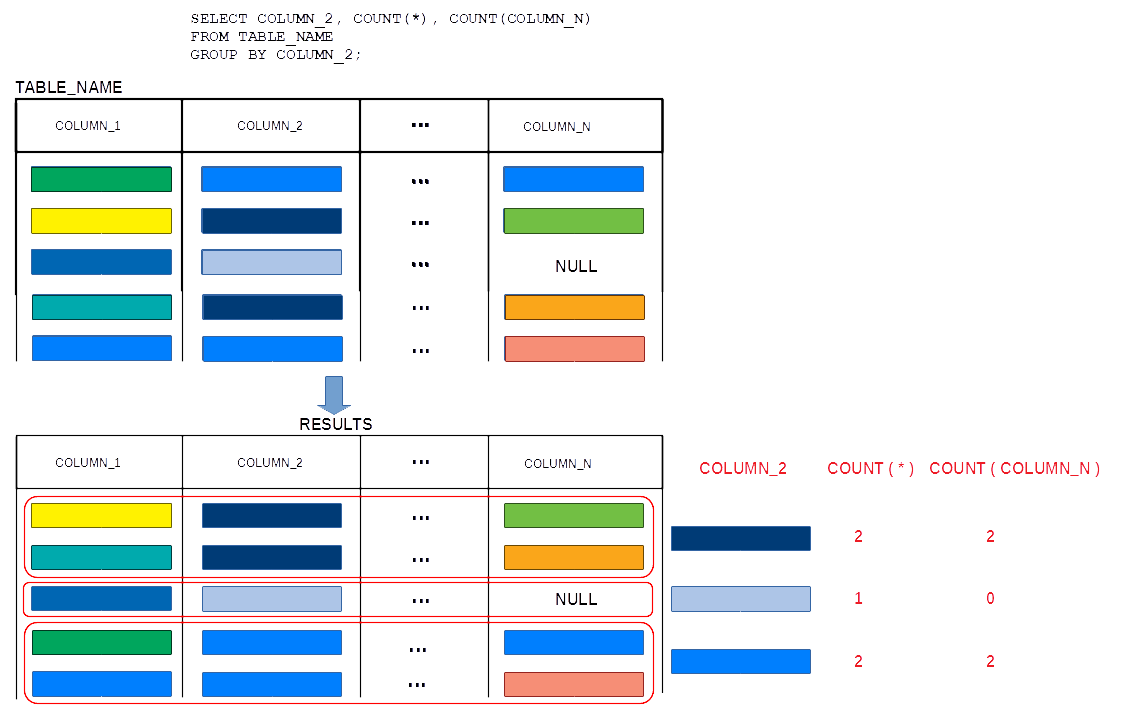
Grouping
- Find the names of all departments that offer at least one course, do not list the same names of departments
SELECT DISTINCT offered_by
FROM COURSE;
SELECT offered_by
FROM COURSE
GROUP BY offered_by;
Grouping
- Grouping allows for application of group functions to each group created by GROUP BY clause
- Find the names of all departments together with the total number of all courses offered by each department
SELECT offered_by, COUNT(*)
FROM COURSE
GROUP BY offered_by;
- Before sorting
+---------+------------+---------+------------------+
| cnum    | title      | credits | offered_by       |
+---------+------------+---------+------------------+
| CSCI111 | C++        |       6 | Computer Science |
| PHYS312 | Relativity |       6 | Physics          |
| MATH111 | Calculus   |      12 | Mathematics      |
| CSCI235 | Databases  |       6 | Computer Science |
| MECH111 | Mechanics  |      12 | Physics          |
+---------+------------+---------+------------------+
Grouping
- Grouping allows for application of group functions to each group created by GROUP BY clause
- Find the names of all departments together with the total number of all courses offered by each department
SELECT offered_by, COUNT(*)
FROM COURSE
GROUP BY offered_by;
- After grouping by offered_by
+---------+------------+---------+------------------+
| cnum    | title      | credits | offered_by       |
+---------+------------+---------+------------------+
| CSCI111 | C++        |       6 | Computer Science |
| CSCI235 | Databases  |       6 | Computer Science |
| MATH111 | Calculus   |      12 | Mathematics      |
| MECH111 | Mechanics  |      12 | Physics          |
| PHYS312 | Relativity |       6 | Physics          |
+---------+------------+---------+------------------+
Grouping
- Grouping allows for application of group functions to each group created by GROUP BY clause
- Find the names of all departments together with the total number of all courses offered by each department
SELECT offered_by, COUNT(*)
FROM COURSE
GROUP BY offered_by;
- After counting rows in each group
+------------------+----------+
| offered_by       | count(*) |
+------------------+----------+
| Computer Science |        2 |
| Mathematics      |        1 |
| Physics          |        2 |
+------------------+----------+
Grouping
- For each value of credit points find the total number of courses that have the respective credits
SELECT credits, COUNT(*)
FROM COURSE
GROUP BY credits;
SELECT offered_by, SUM(credits)
FROM COURSE
GROUP BY offered_by;
SELECT MAX(total)
FROM (SELECT COUNT(*) total
      FROM COURSE
      GROUP BY offered_by) T;
SELECT statement (2)
Outline
Grouping with selections
- Find the names of all departments that offer more than 1 course
SELECT offered_by, COUNT(*)
FROM COURSE
GROUP BY offered_by;
+------------------+----------+
| offered_by       | count(*) |
+------------------+----------+
| Computer Science |        2 |
| Mathematics      |        1 |
| Physics          |        2 |
+------------------+----------+
Grouping with selections
- Find the names of all departments that offer more than 1 course
SELECT offered_by, count(*)
FROM COURSE
GROUP BY offered_by
HAVING count(*) > 1;
+------------------+----------+
| offered_by       | count(*) |
+------------------+----------+
| Computer Science |        2 |
| Physics          |        2 |
+------------------+----------+
References
- C. Coronel, S. Morris, A. Basta, M. Zgola, Data Management and Security, Chapters 5, 7, Cengage Compose eBook, 2018, eBook: Data Management and Security, 1st Edition
- T. Connoly, C. Begg, Database Systems, A Practical Approach to Design, Implementation, and Management, Chapters 6.3.1 - 6.3.4 Data Manipulation, Pearson Education Ltd, 2015
- D. Darmawikarta, SQL for MySQL A Beginner’s Tutorial, Chapters 2 - 5, Brainy Software Inc. First Edition: June 2014
- How to ... ? Cookbook, How to implement queries in SQL, Recipe 5.1 How to implement SELECT statements with simple Boolean expressions ?
- How to ... ? Cookbook, How to implement queries in SQL, Recipe 5.2 How to implement SELECT statements with the set algebra operations ?
- How to ... ? Cookbook, How to implement queries in SQL, Recipe 5.3 How to implement SELECT statements with GROUP BY and HAVING clauses ?