Java MapReduce Application
Outline
Building blocks of MapReduce program
- Structure of MapReduce Java Application
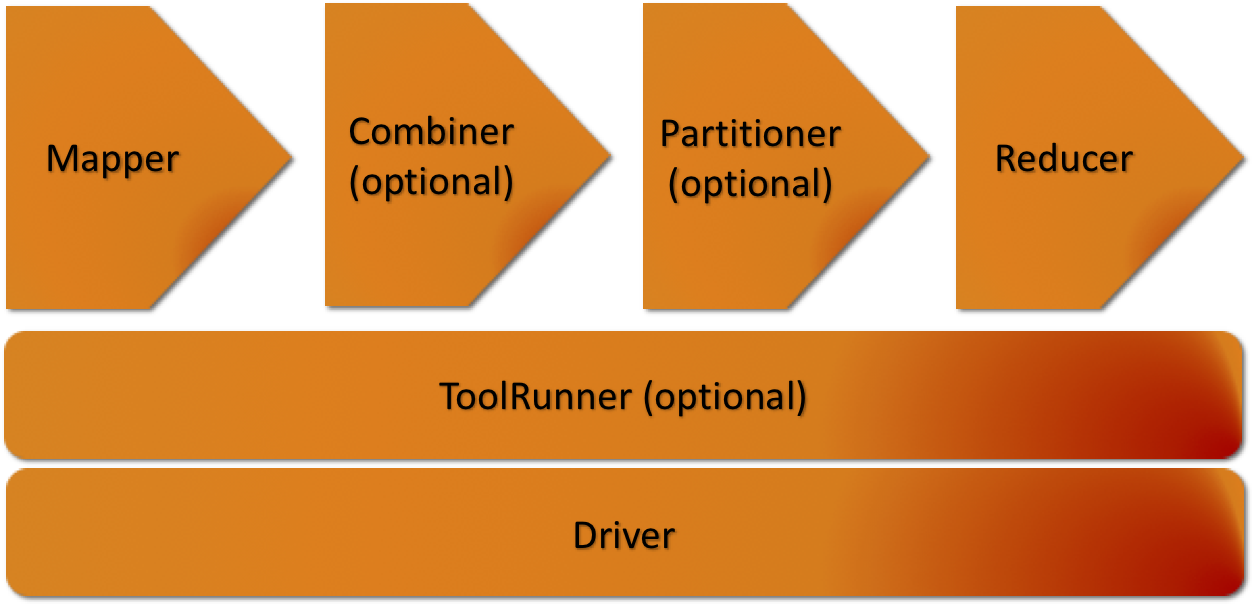
Building blocks of MapReduce program
- Mapper, Reducer, Combiner, and Partitioner classes correspond to their counterparts in the MapReduce model
- These classes implement the MapReduce logic
- The Driver or ToolRunner in a MapReduce program represents the client program
- The main method of a MapReduce program is in the Driver or ToolRunner
- The code of the two is very standard
Building blocks of MapReduce program
- An elementary MapReduce program consists only of a Mapper class, a Reducer class and a Driver
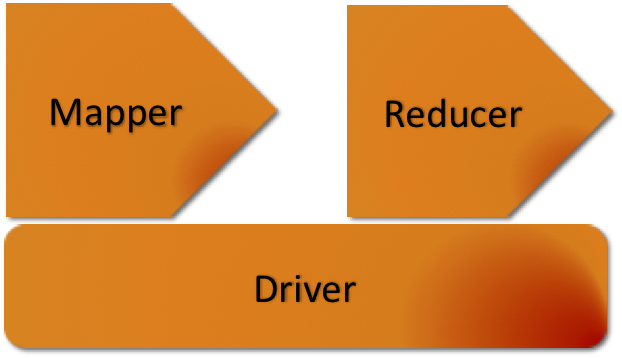
- As the main method is contained in the Driver, sometimes (but not always) it is convenient to make Mapper and Reducer as inner classes in Driver, which contains routine codes
Building blocks of MapReduce program: Driver
- Driver is the program which sets up and starts a MapReduce application
- Driver code is executed on the client; this code submits the application to the ResourceManager along with the application's configuration
- Driver can submit the job asynchronously (in a non-blocking fashion) or synchronously (waiting for the application to complete before performing another action)– the second way will be used in our examples
- Driver can also configure and submit more than one application; for instance, running a workflow consisting of multiple MapReduce applications
Building blocks of MapReduce program: Mapper
- Mapper Java class contains a map() method
- Its object instance iterates through the input to execute a map() method, using the InputFormat and its associated RecordReader
- The number of HDFS blocks for the file determines the number of input splits, which, in turn, determines the number of Mapper objects (or Map tasks) in a MapReduce application (also see the previous lecture)
- Mappers do most of the heavy lifting in data processing in MapReduce, as they read the entire input file for the application
- Mappers can also include setup and cleanup code to run in any given object lifespan
- Setup is called before the map() method; cleanup is called after it
Building blocks of MapReduce program: Reducer
- Reducer runs against a partition and each key and its associated values are passed to a reduce() method inside Reducer class
- Reduce's InputFormat matches Mapper's OutputFormat
- While Mapper usually do the data preparation, for example, filtering and extracting), Reducer usually contains the main application logic
- For example, summation, counting, and averaging operations are implemented in Reducers
- The runtime of Reducer instances is usually faster (and much faster in some cases) than the runtime of Mapper instances
Java MapReduce Application
Outline
Hadoop streaming
- Hadoop streaming is an utility that allows to create and process Map/Reduce jobs with any executable or script as the mapper and/or the reducer
- For example counting lines and words and characters in a file located in Input folder in HDFS
mapred streaming -input Input -output Output -mapper /bin/cat -reducer /usr/bin/wc
Hadoop streaming
- In the example below
mapred streaming -input /user/words.txt -output /user/output -mapper /bin/cat -reducer /usr/bin/wc
word1 word2
word3
2 3 20
Hadoop streaming
- Processing of mapper is performed in the following way:
- A mapper starts processing the executable (in our example /bin/cat) as a separate process when the mapper is initialized
- The mapper converts its inputs into lines and feeds the lines to the standard input of the process
- Simultaneously, the mapper collects the lines from the standard output of the process and converts each line into a key/value pair
- The key/value pairs are collected as the output of the mapper
- By default, the prefix of a line up to the first tab character is the key and the rest of the line (excluding the tab character) is the value
Hadoop streaming
- Processing of reducer is performed in the following way:
- A reducer task starts its executable (in our example /user/bin/wc as a separate process
- The reducer task converts its input key/values pairs into lines and submits the lines to the standard input of the process
- Simultaneously, the reducer collects the lines from the standard output of the process and converts each line into a key/value pair
- The key/value is collected as the output of the reducer
- By default, the prefix of a line up to the first tab character is the key and the rest of the line (excluding the tab character) is the value
Hadoop streaming
- Hadoop streaming supports streaming command options as well as generic command options
mapred streaming [genericOptions] [streamingOptions]
-conf configuration_file      Specify an application configuration file
-D property=value 	      Use value for given property
-fs host:port or local 	      Specify a namenode
-files 	Optional 	      Specify comma-separated files to be copied to the Map/Reduce cluster
-libjars 	              Specify comma-separated jar files to include in the classpath
-archives 	              Specify comma-separated archives to be unarchived on the compute machines
Hadoop streaming
- Sample applications of generic command options
- Specifying map-only jobs
-D mapreduce.job.reduces=0
-D mapreduce.job.reduces=2
-D stream.map.output.field.separator=.
-D stream.num.map.output.key.fields=4
Hadoop streaming
- Streaming command options include
-input directoryname or filename      Input location for mapper
-output directoryname 	Required      Output location for reducer
-mapper executable or JavaClassName   Mapper executable, default IdentityMapper
-reducer executable or JavaClassName  Reducer executable, default IdentityMapper
-file filename                        Make the mapper, reducer, or combiner executable available locally
-inputformat JavaClassName 	      Class you supply should return key/value pairs of Text class
-outputformat JavaClassName 	      Class you supply should take key/value pairs of Text class
-partitioner JavaClassName 	      Class that determines which reduce a key is sent to
-combiner streamingCommand or JavaClassName  Combiner executable for map output
-cmdenv name=value 	              Pass environment variable to streaming commands
-inputreader 	                      For backwards-compatibility: specifies a record reader class
-verbose 	                      Verbose output
-lazyOutput 	                      Create output lazily
-numReduceTasks 	              Specify the number of reducers
-mapdebug 	                      Script to call when map task fails
-reducedebug 	                      Script to call when reduce task fails
Hadoop streaming
- Sample applications of streaming command options
- Specifying Java class as the mapper and/or the reducer
mapred streaming -input Input -output Output \
	         -inputformat org.apache.hadoop.mapred.KeyValueTextInputFormat \
                 -mapper org.apache.hadoop.mapred.lib.IdentityMapper \
                 -reducer /usr/bin/wc
mapred streaming -input Input -output Output \
                 -mapper myPythonScript.py \
                 -reducer /usr/bin/wc \
                 -file myPythonScript.py
-inputformat JavaClassName
-outputformat JavaClassName
-partitioner JavaClassName
-combiner streamingCommand or JavaClassName
Java MapReduce Application
Outline
Word Count: The "Hello, World" of MapReduce
- Implementation of word count program in Python
- Implementation of mapper mapper.py
#!/usr/bin/env python3

import sys

for line in sys.stdin:
	line = line.strip()
	words = line.split()
	for word in words:
		print ('%s\t%s' % (word, 1))
Word Count: The "Hello, World" of MapReduce
- Implementation of reducer reducer.py
#!/usr/bin/env python3

import sys

current_word = None
current_count = 0
word = None
for line in sys.stdin:
	line = line.strip()
	word, count = line.split('\t', 1)
	try:
		count = int(count)
	except ValueError:
		continue
	if current_word == word:
		current_count += count
	else:
		if current_word:
			print ('%s\t%s' % (current_word, current_count))
		current_count = count
		current_word = word
if current_word == word:
	print ('%s\t%s' % (current_word, current_count))
Word Count: The "Hello, World" of MapReduce
- Implementation of word count program in modern Python
- Implementation of mapper mapper.py
#!/usr/bin/env python3

import sys

def read_input(file):
    for line in file:
        yield line.split()

def main(separator='\t'):
    data = read_input(sys.stdin)
    for words in data:
        for word in words:
            print '%s%s%d' % (word, separator, 1)

if __name__ == "__main__":
    main()
Word Count: The "Hello, World" of MapReduce
- Implementation of reducer reducer.py
#!/usr/bin/env python3

from itertools import groupby
from operator import itemgetter
import sys

def read_mapper_output(file, separator='\t'):
    for line in file:
        yield line.rstrip().split(separator, 1)

def main(separator='\t'):
    data = read_mapper_output(sys.stdin, separator=separator)
    for current_word, group in groupby(data, itemgetter(0)):
        try:
            total_count = sum(int(count) for current_word, count in group)
            print "%s%s%d" % (current_word, separator, total_count)
        except ValueError:
            pass

if __name__ == "__main__":
    main()
Java MapReduce Application
Outline
Word Count: The "Hello, World" of MapReduce
- Sample processing of MapReduce job
mapred streaming  -input /user/words.txt  -output /user/output \
         	  -mapper ./mapper.py  -reducer ./reducer.py
$HADOOP_HOME/bin/hadoop jar $HADOOP_HOME/share/hadoop/tools/lib/hadoop-streaming-3.3.6.jar \
                  -input /user/numbers.txt -output /user/outputm \
                  -mapper ./filter.py -reducer ./reducer.py
Miscellaneous
- Compound MapReduce jobs
- How to turn a (possibly complex) data processing problem into the MapReduce model ?
- As a rule of thumb, for complex data processing problems, think about adding more jobs, rather than adding the complexity to jobs
- For example, to find the mean of maximum daily temperature in each month in different weather stations, consider these two jobs:
- Compute the maximum daily temperature for every station-day key
- Compute the mean of the maximum daily temperature for every station-day-month key
- A library ChainMapper allows to develop chained MapReduce Jobs
References
- White T., Hadoop The Definitive Guide: Storage and Analysis at Internet Scale, O'Reilly, 2015
- Hadoop Streaming
- Hadoop with Python
- Writing An Hadoop MapReduce Program In Python